



















AI in Manufacturing Benefits and Use Cases
Key takeaways
- AI is an essential technology for manufacturers aiming to stay ahead.
- Manufacturers are no longer experimenting but are actively integrating AI.
- Manufacturing companies should eliminate legacy systems, siloed data, and poor IT-OT integration.
- AI’s influence extends beyond data analysis.
- AI-powered solutions are accomplishing tasks more precisely than humans.
- Manufacturing units are transforming into modern, smart, and dynamic facilities with AI.
- Businesses planning to invest in AI need to think beyond incremental improvements and use AI for end-to-end process augmentation.
- Adaptive AI is critical for both greenfield and brownfield manufacturing
Future trends for AI technology in manufacturing point to a shift from isolated pilot tests to integration across the entire production stack; product design, production, and delivery will be totally automated.
The latest proof came from a report indicating that profit margins will increase by 38 percent by 2035. Another fact supporting this is that artificial intelligence is reducing maintenance costs by up to 30% and machine downtime by 45%; another indicates that 84 percent of manufacturers are generating measurable value from AI – a bet that AI in manufacturing is moving towards end-to-end process augmentation across operations.
This blog breaks down market shifts, AI features ideal for manufacturers, innovations, use cases, and their implications for businesses in the manufacturing sector.
Quick glance at how AI is transforming manufacturing operations
| Area | What changes AI has brought in manufacturing |
| Predictive maintenance | AI predicts potential equipment failures, reducing unplanned downtime and maintenance costs. |
| Quality control | AI-powered computer vision detects quality issues more accurately. |
| Supply chain | AI improves demand forecasting, logistics, inventory, and decision-making. |
| Process optimization | AI automates workflows, improves throughput, and efficient resource utilization. |
| Decision-making | AI provides real-time insights and predictive analytics helping in faster, data-driven decisions. |
| Product development | AI accelerates product design, prototyping, and testing by analyzing large amounts of engineering and product data. |
| Digital twins | Real-time simulations to test virtually before applying to factory systems. |
| Operational efficiency | AI integrates data across manufacturing operations, reduces waste, optimizes productivity, lowers costs, and enables scalability. |

Looking to integrate AI into your manufacturing operations
Check out our AI development services and talk to our experts
What is AI in manufacturing?
AI is deeply woven into the Industry 4.0 initiatives. It is a progression where technological innovation, creativity, and talent come together to bring speed, efficiency, and accuracy to the manufacturing setup. It encompasses the most advancing industry technology, Artificial intelligence.
AI in manufacturing is the use of computational systems capable of learning, reasoning, solving problems, perceiving, and making decisions, typically associated with human intelligence. With the help of machine learning and neural networks, AI helps industries to optimize their manufacturing processes, reduce waste, manage costs, forecast future demands, and boost productivity.
According to the World Economic Forum, 55% of the manufacturers improved accuracy and detected defects with AI; 30% mentioned that they reduced the energy consumption after deploying AI; 50% increased throughput using AI.
Why is AI playing a critical role in manufacturing?
Operational complexities are increasing in manufacturing. Fragmented data and knowledge have always been a drawback for manufacturing businesses. Precision, speed, and a cohesive approach are important in manufacturing.
AI is a competitive advantage for manufacturers.
Production will no longer run at its limits. Teams will no longer be stretched thin. Planning and decision-making are no longer fragile.
Artificial intelligence in manufacturing has been proven to improve quality, predict equipment failures, optimize production, and support workers on the factory floor.
The global market size of artificial intelligence in manufacturing is projected to reach USD 47.9 billion by 2030, at a CAGR of 46.5% from 2025 to 2030. This shows the critical role of artificial intelligence in manufacturing.
Here are a few examples of how big brands are leveraging AI in manufacturing.
Real-world use cases of AI in manufacturing in 2026
AI ensures zero-defect battery production at BMW’s Gen6 high-voltage battery production plant
BMW’s AI-supported production processes at its new Plant Woodruff plant, with digital twins and virtual reality applications, are a noteworthy step forward in how big brands are investing in artificial intelligence at their modern, state-of-the-art manufacturing units.
The company summarizes its global production strategy as LEAN, GREEN, and DIGITAL, leveraging advanced technologies such as artificial intelligence, data analytics, automation, and virtualization.
What do these examples indicate?
- Companies are using AI beyond predictive maintenance. Their 2026 manufacturing strategies involve AI across the entire production lifecycle.
- AI-powered manufacturing is transforming into intelligent production.
- Automated AI-enabled systems can detect problems, predict, and recommend/take actions.
Physical AI is going to be the second-highest AI investment, says an IDC report, referring to an amalgamation of AI algorithms with physical systems to perceive, interpret, and coordinate operations across manufacturing environments.
In short, AI is critical in the manufacturing industry for faster, more consistent quality checks, better production planning, predictive decision-making, and reducing operational disruptions. With AI, companies can build more resilient manufacturing operations.
What's changing in manufacturing with AI?
AI in greenfield manufacturing (new plants)
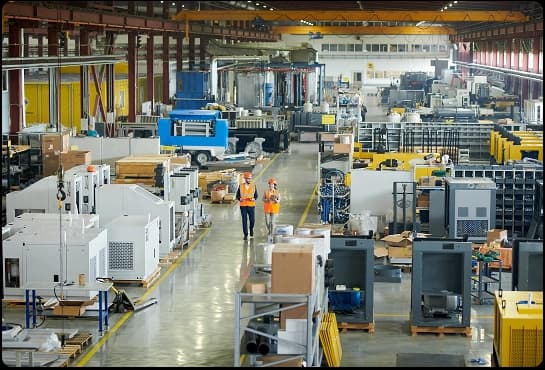
Newly built manufacturing units start with AI now. Right from vision to designing, production to delivery, every phase is clearly supported by artificial intelligence. From day one, industries start operating in speed, accuracy, with scalable AI. The biggest advantage for greenfield manufacturing is that AI can be naturally integrated into the entire factory operations.
Key AI uses in greenfield manufacturing includes, digital twins, autonomous robotics, smart scheduling, predictive maintenance, AI-powered robotics, energy optimization, automated quality inspection, smart automation, intelligent production planning, computer vision, AI-ready data infrastructure, and more.
AI in brownfield manufacturing (existing plants)
For older, established factories, Adaptive AI is used in place of reactive AI. Such manufacturing plants are required to make faster decisions, higher productivity, and quality with reduced downtime and waste. It should be able to sense real-time conditions across operations, analyze data continuously, and act instantly. Intelligence should be embedded within every workflow with an adaptive approach. AI plays a bigger role here.
Key AI use cases in brownfield manufacturing include, predictive maintenance, sensors, computer vision, process optimization, legacy system monitoring, production forecasting, scheduling, energy management, quality control, bottleneck detection, closed-loop execution, supply chain optimization, digital twin retrofitting, worker assistance, real-time, event-driven decision-making, and more.
Overall, as manufacturing operations are unified due to digitization, AI enables manufacturers to make faster, real-time, data-driven decisions. It brings automation, identifies defects, and enables proactive production approaches.
One can downsize or upsize AI involvement depending on the industrial requirements. Adaptive AI is critical for established industries which means AI that continuously adapts to changing conditions. For those in the early stage, AI is still critical for achieving accuracy and speed.
This makes AI an important technology for improving efficiency, maintaining quality, reducing downtime, and building more resilient manufacturing operations, be it greenfield or brownfield plants.
Top 10 benefits of manufacturing AI

Artificial intelligence
Manufacturing units are turning into smart, modern, and scalable facilities with AI.
Automated & unified workflow
From isolated task automation to fully unified, smart systems that work seamlessly across production, quality, and maintenance.
Predictive maintenance
By integrating AI with manufacturing data, manufacturers can predict and prevent machine failures. This, in turn, reduces downtime.
Reduced cost
Automation and predictive analytics reduce labor costs, minimize material waste, and lower energy use.
Quality control
Computer vision and sensors spot tiny defects even on fast-moving assembly lines.
Supply chain optimization
AI forecasts demand, adjusts raw material orders, and manages inventory levels in real time.
Workers' safety
Collaborative robots work towards the safety of human workers.
Digital twins
Virtual replicas enable decision makers to test production changes safely before implementation.
Industrial IoT
Networks of smart sensors gather factory data to feed AI systems.
Generative design
AI creates optimized designs using simulations.
Core AI innovation in manufacturing
Agentic AI is the new core AI innovation for the manufacturing sector in 2026 that promises to deliver over and above 90% of Industry 4.0 principles through speed, automation, real-time visibility, and end-to-end AI-driven manufacturing operations. Agentic AI refers to autonomous models that can function independently, learn on their own, reason, interact with other systems, execute actions, and work orders without getting tired.
What does this mean for businesses in the manufacturing sector?
Success in the manufacturing AI race is determined not merely by technological adoption but by which AI systems matter most to your business. It starts with identifying outcomes, co-creating outcomes with AI, prioritizing outcomes, and creating contextual implementation that delivers the envisioned outcome. The effective implementation of AI into a manufacturing operation starts with the right consultation. A reputed and reliable AI development company like SHALIGRAM can introduce AI into your manufacturing unit in the right direction and shape it to optimize every task within your production unit.
Future Trends
“Change how much you want and get value sooner.”
The critical role of artificial intelligence in manufacturing cannot be underestimated. According to Deloitte’s survey report, 84 percent of manufacturers are already generating measurable value from AI.
Artificial intelligence has emerged as a revolutionary technology, and its impact on the manufacturing sector is intense and will only deepen in the days to come. To ensure the result is advantageous, businesses, technology providers, and policymakers must work together.
The future of AI manufacturing is a shift from reactive to a proactive to adaptive approach. This technology is coming into its own now. AI expertise, application, and experience will define competitiveness. For these reasons and more, SHALIGRAM has been focusing its efforts on exploring AI’s future role in manufacturing through its wide range of AI development services.
Quick pay back wins
It is not about overengineering. It is about identifying an AI solution that works faster for your business and delivers value quickly. Manufacturers must scale AI systematically with data, governance, and the best deployment models, shifting from pilots to manufacturing-wide operations.
To remove the risk of failure, start with proper guidance. Aim to structure the pipeline, scale from pilot to multi-site rollout.
FAQs
Frequently asked questions about the role of AI in Manufacturing industry, use cases and benefits.
When manufacturing AI was invented, the models were just answering your queries. A few years later, the models evolved further to solve problems, forecast demand, and automate manufacturing workflows. Currently, AI in manufacturing is progressive. They can sense, respond, and handle end-to-end manufacturing operations without human intervention. Humans are involved only in strategizing production.