














Legacy System Modernization With Minimal Business Disruption
Transform your aging applications, outdated architectures, and disconnected enterprise systems into secure, scalable, and AI-ready platforms.
What are the signs that your legacy application needs modernization?
Legacy systems slow down businesses and create performance issues. Most legacy systems that once powered growth now impede it with their outdated IT infrastructure. Inefficient, vulnerable systems that aren’t compatible with cloud and AI environments need modernization. At SHALIGRAM, we add new capabilities to your aging, failing, and low-performing legacy systems and re-engineer them for today’s AI-dominated business environments.
Our legacy system modernization services transition your unfit legacy systems into new-age systems built on the latest frameworks, programming languages, and tech stacks. Kyndryl’s State of Mainframe Modernization survey reports ROI achievements from 288% to 362% by modernizing legacy systems.
Signs your legacy application needs modernization
The following warning signs can help you recognize when it’s time to modernize.
- Technology is becoming increasingly expensive to maintain
- Critical systems depend on outdated frameworks or programming languages
- Every new feature requires significant development effort
- System performance is slowing as business volume grows
- Integrations with modern APIs and platforms are difficult
- Data is fragmented across multiple legacy applications
- The system cannot support mobile, cloud, AI, or real-time capabilities
- Your business depends on a few developers who understand the old system
- Users rely on spreadsheets or manual workarounds
- Security patches and compliance updates are becoming difficult
- Releases take weeks or months instead of days
- Vendor or third-party technology is reaching end-of-life

Save time and reduce operational costs
Take our FREE 2-minute online assessment to discover where modernization could save time and reduce operational costs.
When should you consider legacy modernization?
Modernize when your systems become a constraint, not an asset. The triggers below are signs for CEOs/CTOs that your legacy systems need modernization.
| Trigger | What it means? |
| Rising maintenance costs | More of your IT budget goes toward keeping the system running than improving it |
| Slow product releases | Technology is limiting business agility and time-to-market |
| Security concerns | Unsupported legacy components increase exposure to known vulnerabilities |
| M&A / business expansion | Existing architecture cannot easily scale or absorb new business units |
| Cloud adoption | Legacy infrastructure is preventing cloud migration |
| AI initiatives | Existing systems and data aren’t ready for AI integration |
| Data modernization | Data is trapped in disconnected systems and formats |
| Regulatory changes | Existing architecture cannot adapt quickly to new compliance rules |
| Customer experience problems | Outdated systems are affecting digital experiences across channels |
| Talent shortage | Finding developers for old technologies is becoming difficult and costly |
Our numbers reflect our commitment
What are the business challenges solved through legacy system modernization?


High application maintenance costs
Slow development cycles
Poor system performance
Security vulnerabilities
Limited scalability
Integration bottlenecks
Data silos
Manual business processes
Difficulty adopting AI and automation
Infrastructure and licensing costs
What are the business impacts of legacy system modernization?

Lower technology costs
Modern systems developed on new-age tech stacks don’t drain your resources on maintenance. These high-performing systems have lower operational and feature addition costs.

Faster product releases
Legacy systems’ constraints hamper new product releases. Modernized systems built by the SHALIGRAM team on modular architectures have shorter release cycles.

Improved scalability
Multiply your users, data, and transactions without breaking the system. Cloud-powered architecture easily handles sudden loads and seasonal peaks.

Better security
Modernized systems have formidable security measures supported by AI-assisted access management and continuous security monitoring and audits.

Connected enterprise systems
Modernize legacy systems to seamlessly connect enterprise solutions from ERP, CRM, and inventory management to accounting, POS, and warehouse systems.

AI readiness
Rearchitecting legacy applications with modern core features and competencies prepares them for integrating with AI models and agents.
Our technology modernization services shaping enterprise operations
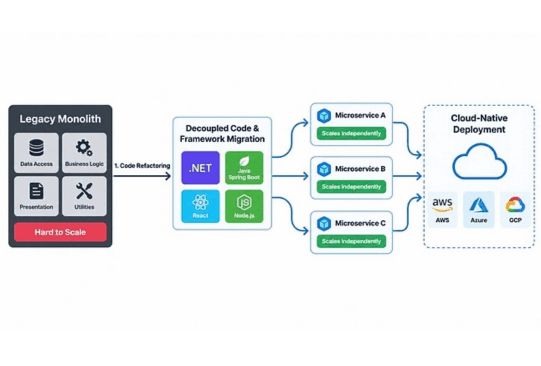
Application modernization
We restructure, refine, and recode applications to modernize them and make them easier to update, scale, and integrate.
- Monolith → Microservices: We break tightly coupled code into independent services that deploy and scale separately.
- Legacy framework → Modern application frameworks:We move code from unsupported frameworks to current ones such as .NET, Java Spring Boot, React, and Node.js.
- On-premises application → Cloud-native application:We rebuild applications to run natively on cloud environments such as AWS, Microsoft Azure, or Google Cloud.
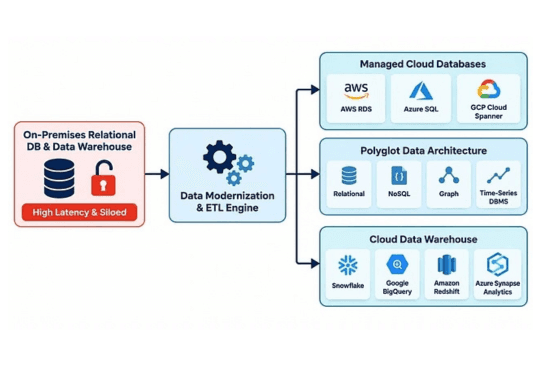
Database modernization
We move data to databases that match today’s volume, speed, and access needs.
- Legacy databases → Cloud databases: We migrate your valuable enterprise data from unsecured on-premises databases to highly secure managed cloud database services.
- Relational-only architecture → Polyglot data architecture: We add your data architecture from relational-only databases to NoSQL, graph, and time-series DBMS.
- Legacy data warehouse → Cloud data warehouse: We transition your data from old-school data warehouses to modern ones such as Google BigQuery, Amazon Redshift, Azure Synapse Analytics, and Snowflake.
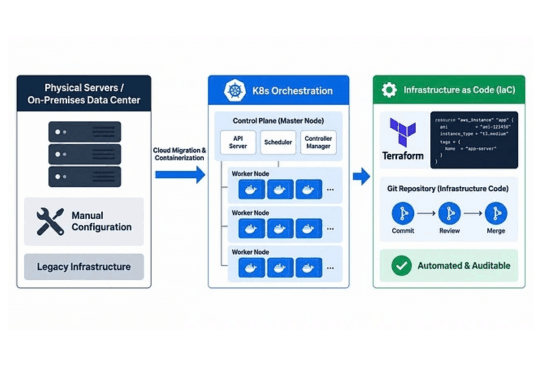
Infrastructure modernization
From UI/UX updates and code refactoring to newer capabilities for performance enhancement, we transform your legacy systems into automated infrastructure.
- Data center → Cloud: We plan and run migrations to public, private, or hybrid cloud environments.
- Physical servers → Containers: We package applications with Docker and orchestrate them with Kubernetes.
- Traditional infrastructure → Infrastructure as code: We define environments in code with tools like Terraform for repeatable, auditable deployments.
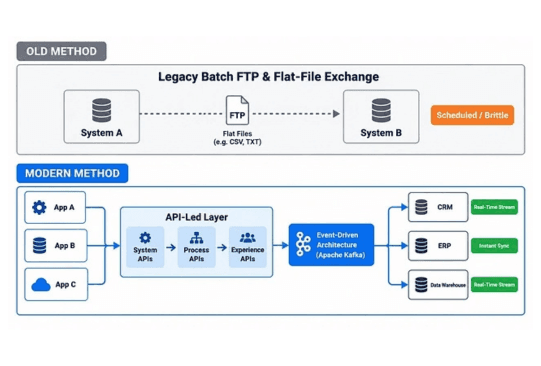
Integration modernization
We replace brittle connections with reusable, real-time integration.
- File transfers → APIs: We replace scheduled FTP and flat-file exchanges with secure REST APIs.
- Point-to-point integrations → API-led integration: We organize integrations into reusable system, process, and experience API layers.
- Batch integrations → Event-driven architecture: We stream business events through message brokers such as Apache Kafka, so systems react instantly.
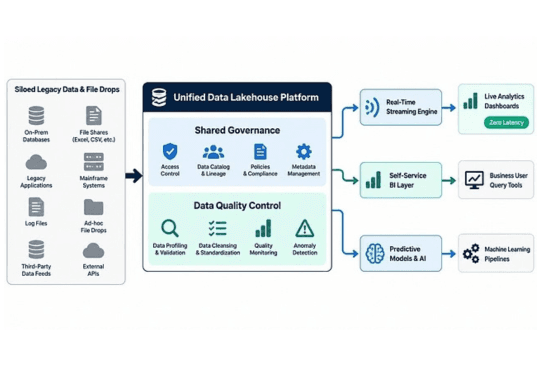
Data modernization
We turn scattered legacy data into trusted, analytics-ready assets.
- Siloed data → Unified data platforms: We consolidate data into lakehouse or warehouse platforms with shared governance.
- Batch reporting → Real-time analytics: We replace overnight reports with live dashboards fed by streaming data.
- Traditional BI → Modern analytics + AI: We add self-service BI and predictive models to your reporting stack.
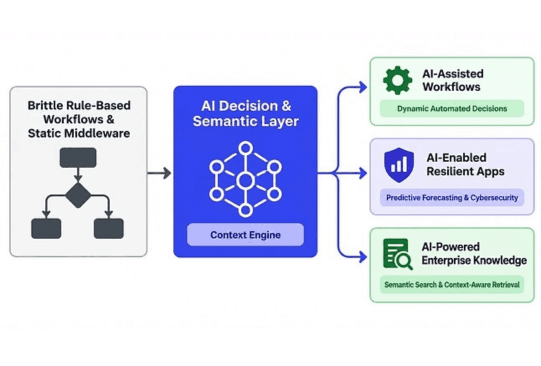
AI modernization
We add intelligence to systems that are built on a brittle foundation, old middleware, and have exposure risks.
- Rule-based workflows → AI-assisted workflows: We transform your rule-based workflows with static capabilities to dynamic decision-making led by AI.
- Traditional applications → AI-enabled applications: We change traditional apps into AI-powered ones that excel at forecasting, analysis, and have greater resilience to cyber risks.
- Static knowledge systems → AI-powered enterprise knowledge:Transform your knowledge systems from static to semantic and context-aware knowledge retrieval systems.
What are the most common legacy systems businesses are modernizing today?
SHALIGRAM helps businesses transition their legacy apps, data, and IT assets from aging on-premises servers to cost-effective cloud environments. Newer systems have improved accessibility, reduced hardware costs, and managed security.
Our team is adept at migrating physical to virtual (P to V) clouds and even your virtual on-premises infrastructure to cloud environments. We also optimize your applications to ensure compatibility with single/multi/hybrid cloud environments.


What our clients say about working with us

They are truly solution focused company! Designed and built a scalable, branded platform that lets clients create tailored reward schemes for employees and channel partners, with a smooth path from points issuance to redemption. Project was split in 4 milestones with description of each milestone and they were tracked during the development cycle and UAT was performed to accept as successful delivery of project. Excellent Project Management Team. All items were reviewed and delivered with the high standard.

Completed and functioning CRM system. Great project management, clear communication, the team provided all deliverables on time. Also responsive post sale, which make a nice change. Good communication, delivered in a timely manor.


Their team's expertise, attention to detail, and problem-solving skills were impressive. The custom software solution developed by SHALIGRAM has significantly improved our operational efficiency and customer satisfaction. We have experienced a noticeable increase in productivity, faster response times to client inquiries, and a more seamless transaction process.


We were impressed with their commitment and their willingness to consider novel approaches. The project was very challenging and the team stayed committed and positive throughout the entire endeavor. We even managed to finish the project during a global pandemic.


Which modernization approach is right for your legacy system?
| Strategy | When it makes sense | What changes? | Business objective |
| Retain | System still meets business needs and has manageable risks | Minimal / No change | Continue operations |
| Rehost | Application works but infrastructure needs modernization | Infrastructure | Move to modern infrastructure |
| Replatform | Application needs a newer platform, but core functionality remains valuable | Platform / Runtime | Improve performance & operations |
| Refactor | Code has become difficult to maintain but business logic remains valuable | Codebase | Improve maintainability |
| Rearchitect | Current architecture limits scalability, integration, or agility | Architecture | Enable scalability & flexibility |
| Replace | System is too costly, restrictive, or outdated to modernize effectively | Entire application | Adopt a modern system |
| Retire | Application no longer provides sufficient business value | Application removed | Reduce complexity & cost |
Legacy systems we modernize across industries
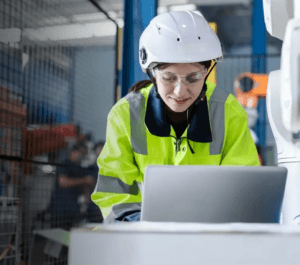
Manufacturing legacy system modernization
Legacy manufacturing software is inefficient at providing modern manufacturers with real-time data insights for lean production practices.
➔ Manufacturing legacy systems commonly modernized:
We modernize legacy ERP, MES, production planning, quality management, inventory, and shop-floor applications.
➔ Manufacturing system modernization opportunities:
We migrate these systems to the cloud and connect them with IoT sensors. Your plants get real-time production planning insights, raw material consumption analysis, AI-assisted quality checks, and integrated planning across facilities.

Modernize Without Putting Business Operations at Risk
Assess
Prioritize
Modernize
Integrate
Migrate
Optimize

Want to assess your legacy business system?
Understand where your legacy system is holding your business back, what should be modernized, and how to move forward with a practical modernization roadmap.
FAQs
Yes, we do that by default. We assess the existing legacy infrastructure, network, and vendor dependencies, data needs, feature needs, and more to create a proper roadmap for what actually requires modernization for your business systems.