


















12 Big Data Use Cases Across Industries (With Real Examples)








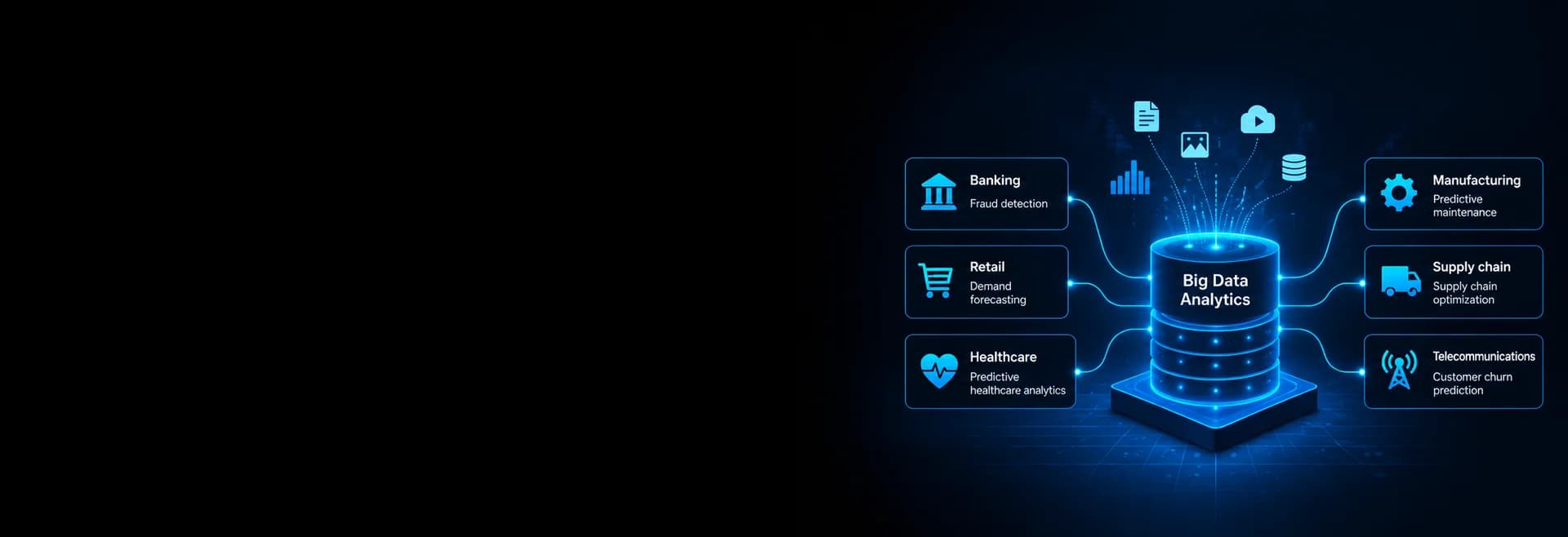
Every company/business across the world is collecting a large amount of data. This data is in different forms and generated from different sources such as sales transactions, customer interactions, connected devices, and other internal systems. However, it is important to note that having so much data does not directly help businesses make the right decisions. Big Data analytics helps them fill this gap, and 12 Big Data use cases will help you understand how.
Big Data helps businesses spot patterns, predict what may happen next, reduce risk, and run operations more efficiently. In this blog on Big Data use cases with real examples, you will understand how real companies turn raw data into measurable results.
What is big data?
Big Data refers to a large amount of data a business collects from different sources that cannot be handled or managed with traditional methods like spreadsheets or legacy applications, nor processed by old methods.
It helps businesses in multiple ways, such as making business-centric decisions, improving customer satisfaction, reducing failures, improving productivity, and more.
What are big data use cases?
A Big Data use case is a specific business problem that a business solves by collecting, processing, and analyzing large amounts of data generated from different sources and in different formats. This data is non-uniform and generated very quickly. Here, teams use analytics, machine learning, and statistical methods to analyze data and gain insights that help them make critical business decisions.
Let’s understand this with an example of a Big Data use case:
A retailer collects massive data at the end of every month. This includes sales transactions, browsing interactions, and inventory records. Practically, it becomes impossible for him to study that data manually or with a legacy system. So, he uses Big Data to analyze this data, predict demand in the coming months, understand customer behavior, and avoid stockouts during peak season.
12 big data use cases at a glance
According to a report, more than 95% of businesses invest in or depend on Big Data infrastructure. To help you understand Big Data’s influence and use across industries, we have prepared an industry-wise comparison table. The table also includes a brief overview of the respective use cases and primary business benefits.
| Industry | Use case | Primary business benefit |
| Banking | Fraud detection | Reduce fraudulent transactions |
| Financial services | Credit risk analytics | Improve lending decisions |
| Retail | Personalized recommendations, Improve customer experience and sales | Improve customer experience and sales |
| Retail | Demand forecasting | Optimize inventory |
| Supply chain | Supply chain optimization | Reduce delays and inefficiencies |
| Manufacturing | Predictive maintenance | Reduce equipment downtime |
| Healthcare | Predictive healthcare analytics | Support earlier intervention |
| Telecommunications | Customer churn prediction | Improve customer retention |
| Cybersecurity | Threat detection | Identify suspicious activity |
| Transportation | Route optimization | Improve delivery efficiency |
| Marketing | Customer segmentation | Improve campaign relevance |
| Hospitality and commerce | Dynamic pricing | Optimize revenue |
12 Real-world big data use cases across industries
Use case 1: Fraud detection in banking
Every day, banks and financial institutions handle millions of transactions. They have every security measure in place to protect money and clients’ sensitive information. But fraudsters are getting more advanced, and a single missed attack can damage their reputation and customers’ trust.
This is where Big Data analytics helps them keep fraudsters and online threats at bay. It closely monitors every client’s behavior and other key patterns. If the models detect anything unusual or patterns that deviate from the client’s standard behavior, they immediately alert the banks and security teams. All of this happens in a fraction of a second, allowing banks to approve or decline transactions in a split second.
Visa reported in 2019 that it used artificial intelligence to analyze 100 percent of transactions on VisaNet. Each one was scored on more than 500 risk attributes in about one millisecond, helping prevent an estimated $25 billion in annual fraud.
Big data in banks and financial institutions helps them avoid fraud and address issues more effectively. It also helps them keep their genuine customers happier.
Use case 2: Credit risk assessment in financial services
Lenders must decide who gets credit and on what terms. Borrowers’ finances change, so a risk picture that is months old may mislead.
Lenders analyze payment history, account transactions, loan performance, and other legally permitted data to rate credit risk and monitor it over time. The goal is earlier warning, not just a one time approval. Teams must also keep decisions fair, protect customer privacy, and explain results to customers and regulators.
Risk.net reported in 2019 that NatWest estimates it touches about 25 percent of UK transactions, adding around nine billion payment records every day. The bank was building an early warning system that maps links between customers to spot problems spreading across firms.
The payoff is better risk monitoring and sounder lending decisions, with warning signs spotted earlier.
Use case 3: Personalized product recommendations in retail
In a shop or on an e-commerce site there are literally thousands of products available. If the customer doesn’t see what they’re looking for at first glance they will walk away. The retailer has to show them the product they’re after as soon as they get there.
They use Big Data analytics for this. To recommend products to customers they look at their browsing behavior, their purchase history and what products they’ve searched for recently.
For instance, a customer who has bought a smartphone will see other smartphone related products (mobile accessories etc). If the same customer then searches for baby gear the product recommendations will change to baby care products. The recommendations change as the customer’s behavior changes.
Amazon’s item to item filtering (described in Amazon Science in 2019) looks at a user’s recent purchases and for each item will find other items that it’s likely they’ll also buy. Two items are deemed related if users who have bought one are unusually likely to go on and buy the other.
Retailers get better product discovery and engagement (a path to higher conversion) as each visit will show them more relevant choices.
Use case 4: Demand forecasting and inventory management
Running out of stock during the peak season or overstocking when demand is low is one of the most common problems for retailers worldwide. This also causes them to lose money. Therefore, retailers must have the right amount of stock at the right time.
Big Data analytics can be used to address the problem of overstocking and understocking. The retailer can use the analytics to look at historical sales data, seasonal sales data, inventory data and all the other relevant signals in order to determine how much to stock.
Let’s understand this with an example: A store selling winter coats in Minneapolis may need them earlier than stores in Houston. This is because winter may arrive earlier in Minneapolis than in Houston. By referring to past seasonal sales data, real-time stock, and expected sales, retailers can stock winter coats.
Walmart said in 2023 that its inventory models (AI-powered inventory management system) learn from past sales, online searches, and page views, then add weather patterns and local demographics. Demand is read down to zip codes, and the systems connect 4,700 stores and Walmart’s suppliers.
The payoff is fewer stockouts, less excess inventory, and better planning for every store and season.
Use case 5: Supply chain optimization
The logistics and supply chain industry is one of the most interconnected industries. All internal operations are interconnected and depend on one another to complete an order. This is why a delay at one supplier or step can trigger a chain of delays that often results in missed or delayed delivery.
Supply chain optimization can get rid of these delays. Optimization models take data from suppliers, warehouses, shipments and inventory and work out exactly why the delays are occurring so that the business can then go on and eliminate them in future. It can also work out the most efficient route to deliver.
Microsoft and Accenture built a Cloud Control Tower that tracks Azure datacenter hardware from component suppliers to finished goods warehouses and on to datacenters. It gives more than 500 decision makers one view and saved hundreds of hours spent preparing data.
The benefits of supply chain optimization are evident: no more shipment delays, a detailed overview of available stock, and fewer operational errors.
Use case 6: Predictive maintenance in manufacturing
Machines that fail without warning will of course bring production lines to a standstill and require expensive emergency repairs. Periodic maintenance either replaces parts early or after an expensive breakdown.
Manufacturers look at sensor readings, temperature, vibration, maintenance history and equipment performance and a small change such as a motor that starts to vibrate a bit more is an early warning. If you can spot that then you can schedule the repair in during planned downtime before the machine fails and takes the line down.
In 2025 Siemens reported that steelmaker BlueScope had avoided some 2,000 hours of unplanned downtime over a three year period using its Senseye platform. According to them, they used real time machine data combined with AI analytics to detect the early signs of wear.
The benefits that a manufacturing company enjoys are less unplanned downtime, zero loss due to failures, and planned maintenance around actual equipment.
Use case 7: Predictive analytics in healthcare
Some medical conditions are hard to detect early on. These conditions not only remain hidden but also worsen quickly once detected, leaving doctors very little time to react and treat them effectively. Such conditions must be detected and treated earlier.
Big Data’s predictive analytics in healthcare help doctors and healthcare organizations detect diseases earlier and treat them before they worsen. Predictive analytics uses past medical histories, real-time monitoring data, lab results, and other data to determine whether a patient is at risk for any hidden medical conditions. With the help of these tools, hospitals and doctors can make better treatment decisions.
A 2022 Nature Medicine study of the TREWS sepsis alert covered 590,736 encounters at five hospitals. Patients whose alerts were confirmed by clinicians within three hours had about 18 percent lower adjusted in hospital mortality, though the study was not randomized.
The potential benefit is earlier risk identification and better clinical decision support, with clinicians making the final call.
Use case 8: Customer churn prediction in telecommunications
Telecom customers switch providers easily, and each one who leaves is a lost customer and a lost revenue stream. Telecom service providers should know which customers are planning to leave their network before they do.
This can be predicted by analyzing customers’ behavior. Telecom companies can review factors such as customers’ monthly usage, service complaints, recharge frequency, and more to calculate their risk of leaving. The teams then segment the at risk customers and assign an action to each group (e.g. a better plan, a call or a fix to a network issue).
SAS reported in 2019 that Vodafone Ukraine had been using segmentation on around 3,000 data points to build retention models and next best offers. The number of targeted communications went from 100 to 2,000 per month and churn was down 30%.
The upside is more targeted retention programs and lower churn as each at risk customer is going to get a relevant action.
Use case 9: Cybersecurity threat detection
Attackers move across email, identities, devices and cloud apps. A security team looking at each system in isolation would only see a small part of the attack.
Security analytics brings together network logs, authentication events, user activity and security alerts from a multitude of systems. The models learn what normal looks like and then flag the odd. A single odd login might be nothing at all in isolation but if you have that in conjunction with some very odd file access it could be a real threat.
Microsoft says it processes over 165 trillion security signals every day. Its 2026 Digital Defence Report states that by correlating endpoint, identity, cloud, email and network telemetry you can uncover attack patterns which would be completely invisible if you were to look at each of those sources in isolation.
The benefit is faster detection and investigation of potential threats as the analysts have the full picture in one place.
Use case 10: Route planning and optimization in transportation and logistics
As the vans go out and stop at hundreds of locations around the city to deliver the parcels, bad route planning will not only waste their time but will also lead to excessive fuel consumption and a reduction in the number of deliveries per day.
Routing is fundamentally a math problem. It’s fed by big data. The logistics companies have all the data they need (traffic conditions, GPS, delivery locations, weather, vehicle data etc) and the routing software takes that data and works out the best stop order and route. The better the data the better the route.
UPS says its ORION system contains data on 250 million addresses and has access to the vehicle data from its trucks. UPS anticipated ORION would save 100 million driving miles per year when fully deployed across the U.S.
The payoff is fewer miles, less fuel consumption and fewer late deliveries for the same number of stops.
Use case 11: Customer segmentation in marketing
Sending the same offer to every customer is a waste of money. A lot of people will simply ignore the message if it doesn’t relate to what they actually buy.
Based on signals and data from CRM, purchase history, and campaign responses, we create different groups. There is a demographic segmentation group in which people are segmented by age, gender, and income, and a behavioral segmentation group in which customers are segmented based on their buying behavior.
Dunnhumby reported in 2021 that their Clubcard reward mailings (to the most loyal customers) contain 6-8 personalized coupons on average and have a 20% redemption rate. The offers are all derived from Clubcard data on what the customer has bought.
The benefit is more targeted campaigns and marketing spend on offers that people are actually going to use.
Use case 12: Dynamic pricing and revenue optimization
Seats, rooms and rides can’t be saved for later. Flat pricing loses revenue when demand is high and leaves capacity empty when demand is low.
The prices of the products go up and down as per the demand, availability, and historical sales data. For instance, if demand is high and supply is low, then the prices go up. Whereas if demand is low and supply is high, prices go down. It works on a simple algorithm of dynamic pricing.
Uber says surge pricing kicks in when demand for rides exceeds the number of cars available. The prices are updated in real time and will vary by area of the city. Riders are informed when surge is in effect and Uber’s service fee percentage remains unchanged.
The benefit is better revenue management and greater capacity, but the prices have to be clean and fair to maintain customer trust.

Turn your raw data into measurable business value
From fraud detection to predictive maintenance, our big data engineers help you build secure, scalable analytics pipelines tailored to your industry.
Benefits and challenges of big data analytics
Big Data analytics helps businesses make critical decisions instantly and accurately based on data. But businesses face real challenges. We have listed the top benefits of Big Data analytics along with the most common challenges businesses face.
Key business benefits of big data
- Improved decision making: It becomes easier for your teams to make better decisions with the help of live data and patterns.
- Operational efficiency: Businesses can now fix the issues that are slowing down processes to improve operational efficiency.
- Better customer experiences: Based on the data, it becomes easy for businesses to understand what their customers need and how to improve their experience.
- Risk management: Fraud, odd activity and operational issues come to light earlier in the cycle, while they’re still small.
Common implementation challenges
The value is genuine, the work just isn’t easy. Those four issues are present in pretty much every sector.
- Data quality: Duplicate, missing or inconsistent records will lead to wrong answers so the data has to be cleaned before it can be trusted.
- Disconnected systems: the data often lives in separate tools which don’t talk to each other and you have to do some planning to get it all joined up.
- Security, privacy and governance: companies have to protect the data, comply with the privacy regulations and decide who can see what.
- Costs and skills: storage, tools and cloud all have a cost and people who know how to run it all are hard to come by.
How to choose the right big data use case for Your business
Every business is unique. How it operates, manages data, and handles customers differs from one another. The same applies to your business.
When choosing the right use case, avoid selecting one solely based on external reviews or feedback. The right use case for your business fits your requirements and addresses your challenges. And to pick the right use case, ask yourself these four questions.
- Business impact: Analyze your operations and find out which problem is affecting your business finances and operations.
- Implementation feasibility: Will the solution work within your existing systems and processes or will it require a complete rebuild?
- Data availability: Data is very important for Big Data analytics; therefore, ask yourself, “Do I have enough accurate data to proceed?”
- Measurable success: will you be able to define clear KPIs to measure the outcome? If not you’ll find it very difficult to demonstrate value.
Let’s understand this with the help of an example:
A manufacturing business that is experiencing equipment failures will go for predictive maintenance use case instead of customer segmentation. This is because equipment failure stops the entire production line, causing financial and productivity losses.
FAQs
The most common big data use cases are as follows: fraud detection use cases, customer analytics use cases, demand forecasting use cases, supply chain optimization use cases, and predictive maintenance use cases.