



















Data Engineering Use Cases: 10 Real-World Examples with Results








Most companies do not have a data shortage. They have a data access problem. Sales data sits in one system. Finance data sits in another. Reports take days, and the numbers still do not match.
Bad data is expensive. Gartner proved this in 2020. According to a report published by Gartner, organizations lose more than $12 million every year to bad or poor-quality data. Therefore, you need to treat this report as a guide and not a rule. The direction is still clear.
The issue of the low-quality data can be addressed with the help of data engineering. The latter builds the pipelines that move, clean, and store data that an organization can trust and use it as per the requirements.
The issue of low-quality data can be addressed with the help of data engineering. Data engineering builds pipelines that move, clean, and store data that an organization can trust and use to meet its requirements.
In this blog on Data Engineering Use Cases, we will discuss the ten most common use cases with real-world examples. In this guide, we will also talk about the numbers and tools behind them.
What are data engineering use cases?
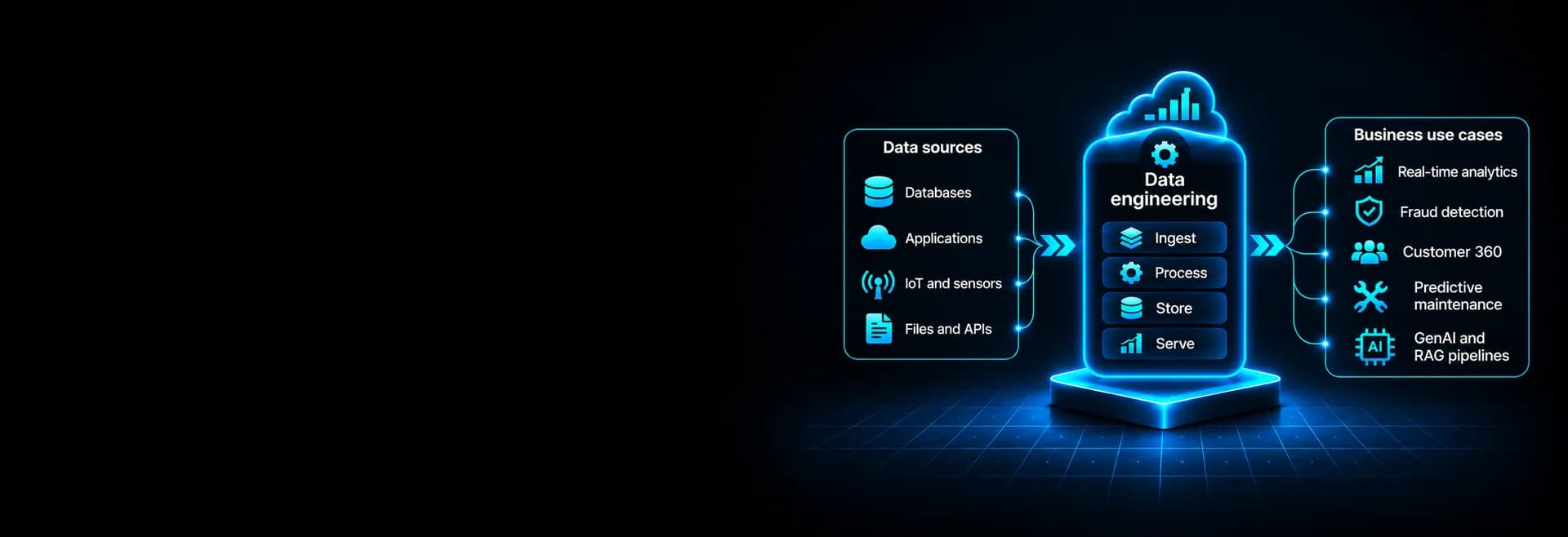
Data engineering use cases are the set of business problems that are solved by building and running data pipelines. During the process, data is collected from different sources, cleaned, stored, and delivered as needed by the business or teams.
Data engineering use cases follow the same path:
- Data sources: Data is collected from different internal or external apps, databases, sensors, and files.
- Ingestion: Data is then pulled in with the help of tools in batches or as a stream.
- Data processing: The data is further processed for industrial and commercial use.
- Data storage: The data which is cleaned and structured is stored in data warehouses, data lakehouses, and data lakes.
- Data serving: The structured, clean data is now served to dashboards, machine learning models, and other AI applications.
When we talk about use cases, please don’t mistake them for a tool. They are business results that an organization achieves by implementing data engineering. Use cases vary by industry and requirements.
Top data engineering use cases at a glance
| # | Use case | Speed needed | Main business owner | Typical tools |
| 1 | Real-time analytics | Seconds | Operations, products | Kafka, Flink, Spark streaming |
| 2 | Warehouse and lakehouse | Minutes to hours | Finance, analytics | Snowflake, BigQuery, Databricks, Hudi |
| 3 | Customer 360 | Minutes to hours | Marketing, sales | Dbt, warehouse, identity matching |
| 4 | Fraud detection | Milliseconds | Risk, compliance | Kafka, Flink, Feature stores |
| 5 | Predictive maintenance | Seconds to minutes | Plant operations | MQTT, Kafka, time series databases |
| 6 | Machine learning pipelines | Mixed | Data science | Airflow, Dagster, MLflow |
| 7 | GenAI and RAG pipelines | Minutes to hours | AI and product teams | Document parsers, vector databases |
| 8 | Data quality and governance | Continuous | Data and compliance leaders | Dbt tests, Great Expectations, catalogs |
| 9 | System integration | Hours | IT, ERP owners | CDC tools, ELT tools, APIs |
| 10 | Cost control | Daily | CIO, Finance | Cloud billing data, FinOps tools |
10 data engineering use cases with real-world examples
Data engineering use case in real-time analytics and reporting
The problem: Reports show what happened yesterday. Teams need to know what is happening now.
What data engineering does: Streaming pipelines capture events as they happen. They send them to dashboards and alerts within seconds.
Real-world example: In 2018, at the O’Reilly conference, a Netflix engineer said that its Keystone pipeline processed 3 trillion events and 12 petabytes of data per day. All this data was used to provide a personalized user experience, track operations, and detect fraud.
Good fit when: This use case is suitable for businesses where a few minutes of delay costs money.
Data engineering use cases by industry
| Industry | Top use cases | Typical data | Why it matters |
| Banking and financial services | Fraud detection, risk, regulatory reporting | Transactions, customer records | Decisions must happen in milliseconds, and audit trails are required |
| Healthcare | Patient data integration, claims analysis, predictive models | Health records, claims, device data | Records sit in many systems, and privacy rules apply |
| Retail and ecommerce | Customer 360, inventory, personalization | Sales, web clicks, supply data | Shoppers expect relevant offers |
| Manufacturing | Predictive maintenance, quality tracking | Sensor, MES, and ERP data | Downtime stops production |
| Logistics | Shipment tracking, route planning, demand forecasting | GPS, orders, warehouse data | Delays show up in customer experience |
| Telecom | Network monitoring, churn analysis | Call records, network logs | Data volumes are very high |
Which data engineering method is right for your business?
If you plan to implement integrated data engineering strategies, the first thing you must do is choose the right method, and to do that, ask yourself: what does a one-hour delay cost you and your organization?
If the answer is nothing, go with the batch method; if the answer is real money, choose the streaming method; and if the answer is both, choose the hybrid method.
| # | Batch | Streaming | Hybrid |
| Delay | Hours or overnight | Seconds or less | Depends on the data |
| Cost | Lower | Higher | Balanced |
| Best for | Financial reports, billing, historical analysis | Fraud, monitoring, personalization | Most enterprise platforms |
| Example | Month-end close | Card payment scoring | Stream clicks, batch finance |
How to pick your first data engineering use case for your business
When choosing your first data engineering use case, consider three key points:
- Does it deliver business value?
- Can your existing IT infrastructure support it?
- What impact will it have on your business?
A proper answer to these three questions will not only help you plan better but also save you from unwanted delays and failures.
Why data engineering projects fail
There are three main reasons why most data engineering projects fail, and they are unclear business goals, messy data, and undefined operations.
For better understanding, we have listed some of the most causes:
- No business owner: The pipeline works, but nobody uses it.
- Weak source data: Bad inputs create bad outputs, however good the tools are.
- Tool first planning. Teams pick a platform before they define the problem.
- Unclear support: Nobody owns the pipeline after launch.
- No monitoring: Failures are not solved until a user complains.
How SHALIGRAM helps with data engineering
SHALIGRAM builds and runs data pipelines, warehouses, and AI-ready data platforms for enterprise and mid-market clients. The approach is simple. Pick one use case. Agree on one metric. Run a short pilot. Then expand.
At SHALIGRAM, we offer a range of data engineering services to meet business needs, and some are mentioned below.
- ETL & ELT Pipeline Development
- Big Data Engineering
- Cloud Data Modernization
- Data Architecture Design
- Data Integration & Transformation
- Analytics & BI Enablement
Talk to SHALIGRAM about your first data engineering use case.
FAQs
The main use cases are real-time analytics, data warehousing, Customer 360, fraud detection, predictive maintenance, machine learning pipelines, GenAI data pipelines, data quality, system integration, and cost control.