


















How AI is Helping Moving Companies Reduce Estimation Errors and Improve Move Pricing
Cost estimation is a fundamental component of moving businesses because it serves as a blueprint for job planning and resource allocation. It involves predicting the financial resources needed to complete a relocation task within a set timeframe. The Success of a moving job often depends on the accuracy of its cost estimates, as these figures guide budget creation and resource planning. However, cost estimation is notoriously complex, and errors can significantly disrupt outcomes.
Reports indicate that 30% are charged more than the actual estimate, even when the mover performed an in-person visit for the estimate. Moreover, consumer complaints to FMCSA about pricing disputes rose 34% between 2023 and 2025.
Estimation errors stand as the top challenge in the moving industry.
Estimation errors often lead to budget overruns, resource shortages, and schedule delays, ultimately affecting trust and business viability. Poor or inaccurate estimates lead to bad reviews, which eventually affect prospects.
What is a moving estimate?
A moving estimate is a document that outlines the predicted cost of your move before the job begins. It includes;
Core service charges – Labor, distance, weight of the consignment, transportation
Ancillary fees – Packing materials, fuel surcharges, stair and elevator fees, warehouse storage fees, long carry fees, furniture disassembly and reassembly, special item moving, appliance moving.
Overall, the packers and movers companies prepare an estimate based on the total weight, distance, services requested, and access conditions.
What are the primary causes of estimation errors?
Overlooking risk and contingency
Rough or overestimation
Skipping pre-move surveys
Poor coordination between teams
Failing to validate the estimate
Not considering indirect costs
Inadequate scope due to incomplete inventory
Not considering current market conditions
Why Accurate Estimation Matters in the Moving Industry?
The cost of an estimation error can be far higher than the cost of getting the estimate right.
Reports indicate that 30% of customers face estimation errors, which directly impacts customer experience and satisfaction. Packers and movers businesses are in a volatile economic environment and face immense pressure to deliver complex moving jobs with speed and precision, with narrow margins.
Although digitalization and operational excellence are currently taking center stage, one core capability that consistently determines success long before execution begins is the accuracy of the cost estimate.
Cost estimation is not just a critical step to initiate a moving job planning process. Its impact is far broader. Accurate estimates shape customer trust and improve business growth.
They guide decisions across teams. As relocation processes grow more complex and customer expectations rise, the need for reliable, intelligent, automated, and data-driven estimating cannot be ignored.
“Speed without accuracy. Accuracy without precision. Precision without quality. Quality without data-backed action creates no business value.”
The Global moving services market is predicted to be valued at USD 170.70 Bn by 2033 According to Coherent Market Insights. Full-service relocation is holding 64.20% of the moving services market share according to Mordor Intelligence. The scope is huge and losing business due to estimate errors can be highly toxic for scalability. Estimation errors are a huge challenge.
The Impact of Estimation Errors on Movers
High level of precision is a differentiator
Packing materials prices fluctuate; specialized labor rates vary between regions; weather conditions are uncertain; regulatory requirements evolve; and even a small miscalculation in the estimating phase can affect the estimate. Precision in estimation is mandatory.
Speed is equally important as accuracy
Movers and packers business customers expect fast, detailed, and data-backed estimates. The challenge is that traditional estimating processes often are time-consuming. This does not match expectations. Organizations need real-time visibility into costs such as truck availability, labor, packaging requirements, weather conditions, and more. Automated AI-powered moving estimation enables teams to generate estimates quickly in real time without sacrificing quality. Speed in delivering a service often becomes a competitive differentiator. AI is the savior.
Transparency is mandatory
FIDI Focus State of the Industry report 2026 clearly indicates “transparency” as the most important factor that customers value the most. The biggest customer behavior shift in the past three years is declining tolerance for friction. In 2026, moving business customers want one-click service ordering, real-time delivery tracking, and instant estimates with transparent pricing.
Error-free estimates lead to accurate move pricing
Guesswork in moving estimate can cause the organization to lose strategic deals. AI-calculated, error-free estimate provides a competitive price that reflects the true value of the service and the cost of delivery.
Accurate cost estimation helps teams carry out the moving or relocation tasks with confidence. It helps businesses undertake projects that match their capabilities and avoid those with hidden risks. Moreover, moving companies can predictively understand the underlying cost drivers in their operations rather than relying on assumptions. This transparency strengthens customer credibility and reliability.
Error-free estimates support predictable moving
A cost estimate is not just a step to start a moving job; it forms the foundation for precise planning, resourcing, and execution. When estimates are accurate, actual pricing is precise.
Reliable estimates eliminate rework by reducing assumptions and establishing data-backed baselines. Accuracy improves governance and compliance, factors that are critical for the packers and movers business. Accurate estimating shifts moving jobs from reactive to proactive.
The future of moving estimate is automated, data-driven, and intelligent
A good percentage of movers and packers companies are still relying on manual processes and spreadsheets and finding it difficult to keep pace with growing complexity of the moving and relocating tasks. The modern approach to estimating integrates data from across the enterprise. It leverages AI-powered analytics to produce more informed and reliable pricing.
This transformation includes adopting virtual cost estimators and automated workflows that share data seamlessly across moving and delivery systems. More and more, organizations are adopting predictive analytics and AI-assisted tools that learn from past moving assignments. These automation tools help relocating teams identify risks and elevate estimating accuracy.
The shift toward automated, intelligent estimating is not only improving accuracy; it is reshaping the way moving businesses compete.
AI-powered moving cost estimation
Two years ago, roughly 20% of packers and movers companies used AI for their moving tasks. Last year, 40% used AI in one form or another. Today, the number is above 70%, which clearly indicates that AI has moved into the mainstream day-to-day workflows of the moving industry.
How is AI helping create faster, more accurate moving estimates?
Creating a moving estimate takes more than a rough calculation with a few parameters. To improve accuracy and precision, packers and movers businesses need to identify inventory, estimate volume, assess labor and vehicle requirements, evaluate moving conditions, and turn all the gathered information into a reliable quote.
Traditional methods, such as manual estimating or simple, isolated systems like spreadsheets and other applications, can create pricing inconsistencies. Estimators can overlook a few factors, which result in inaccurate estimates. Moreover, pricing can vary between similar moves. AI estimates are the best solution to overcome these shortfalls and improve operational efficiency. Different AI automation technologies improve each process.
- AI-powered inventory analysis
- Automated move cost calculation
- Predictive pricing based on historical data
- Real-time adjustment of estimates
AI technologies used for moving cost estimation
The strongest approach is not necessarily one AI technology working alone. Moving companies are now experimenting and combining multiple types of AI right from computer vision for inventory capture, to predictive AI for cost and resource estimation, generative AI for quote creation, and machine learning for continuous improvement. This creates AI-assisted estimation, while keeping human estimators involved merely to validate and approve.
AI virtual estimate solution for packers and movers
AI virtual estimates for moving companies are the best solution in this digital age for accurate moving estimates remotely without an in-person inspection. The solution lets customers record a smartphone video walkthrough of their home or business inventory, enabling AI to instantly assess and prepare an estimate in real time.
How does AI virtual estimating work?
Customers give a walkthrough. Computer vision identifies furniture, boxes, and specialty items using deep learning and image processing capabilities. The AI solution uses guided photo or video capture and analyzes the exact dimensions, angles, weight, and volume of the items. AI automatically generates the estimate.
1. Computer Vision AI for inventory detection
Computer vision analyzes photos and videos of a customer’s home or business area to identify and classify items. It can instantly recognize furniture, appliances, boxes, and other inventory, helping estimators create a digital list without manually checking every item.
- Image recognition models automate visual inspection by quickly identifying objects, processing image data, and labeling them.
- Visual inspection solution to detect micro-issues and classify them.
- Defect detection models detect surface-level defects in furniture, boxes, and other specialty items.
- Inventory and asset recognition solution to track assets in real-time.
Benefits: Faster virtual surveys, improved accuracy, minimal manual intervention, quick anomaly detection, and more consistent inventory capture.
2. Predictive AI for cost and resource estimation
Predictive AI is capable of analyzing past moving data, including inventory volume, labor hours, distance, move type, consignment patterns, market condition, and actual job costs. These AI models are trained to find the most similar past projects and create a comparable estimate by adjusting for size and situation. It provides estimates using probability based on main cost factors. Parses supplier quotes and adjusts units and tax to create a realistic and data-based estimate.
Automate and simplify the estimating process in the moving business, making it a modern, mobile, smart, and adaptive experience. Leveraging predictive AI for moving job cost estimation can enhance the overall efficiency of your estimation processes, resulting in improved accuracy, faster decision-making, and better resource allocation, which has a greater impact on your business growth and customer experience. By using previous transaction patterns, the predictive AI models estimate expected labor, truck capacity, packing requirements, and other cost factors for a new move.
Benefits: Data-driven estimates and smart planning of resources and costs.
3. Generative AI for quote and estimate creation
Generative AI, or GenAI, is an advanced AI model with key capabilities such as automated data processing, conceptual forecasting, and risk and gap detection that turn unstructured inventory and operational data into customer-ready estimates. It can also help estimators review large amounts of moving task information and identify details before finalizing a quote. Latest reports indicate that more and more moving companies worldwide are using Generative AI for faster, more accurate moving estimates.
Benefits: Reduces administrative work and transforms data into a professional estimate.
4. Machine Learning for continuous estimate improvement
Advanced Machine learning models can now learn from completed moves by comparing estimated costs and requirements with actual outcomes. Over time, these models can identify recurring estimation patterns and improve predictions based on new data. Such a predictive approach can potentially improve the accuracy of the estimates and help packers and movers businesses to reduce errors and submit estimates with utmost precision.
Benefits: Estimates can become more consistent and data-driven as the company accumulates more moving data.
AI-powered moving estimation workflow
Analyze photos and videos to identify inventory
AI-powered estimating systems analyze photos or videos of items such as furniture, appliances, boxes, and other inventory. Computer vision is the AI technology used here to classify items and estimate their quantity, dimensions, and volume, reducing the need to manually check and count.
Estimate volume and moving requirement
Once the items are identified, AI assembles them into item-level data to calculate and determine the resources required for the move. This is key to planning truck size, moving crew requirements, packing materials, and other operational needs.
Analyze historical moving data
AI analyzes the company’s past moving data to identify patterns between inventory, move distance, volume, labor requirements, packing needs, and final costs. These insights help improve the reliability of new estimates and identify potential cost or resource issues before a job begins.
Identify potential estimation risks
AI also flags missing information, unusual inventory combinations, potential hidden costs, and other factors that may affect a move’s cost. Identifying issues before the job starts gives estimators time to review the estimate instead of facing unexpected risks during the move.
Generate estimates
AI automates surveys, gathers inventory information, calculates costs, and generates estimates. This helps movers and packers generate moving estimates faster and respond to customer inquiries without relying on time-consuming manual processes.
Validate and refine the estimate
Human estimators then validate the final AI inventory capture, volume calculations, and pricing inputs to finalize the estimate.
Share the estimate with the customer
AI-generated estimates are then automatically shared with multiple departments, including scheduling, crew dispatch, fleet planning, inventory management, billing, and reporting systems. This reduces duplicate data entry and helps ensure that the information captured during estimation is available throughout the move lifecycle. The estimate is also shared with the customer.
The result is a faster estimate.
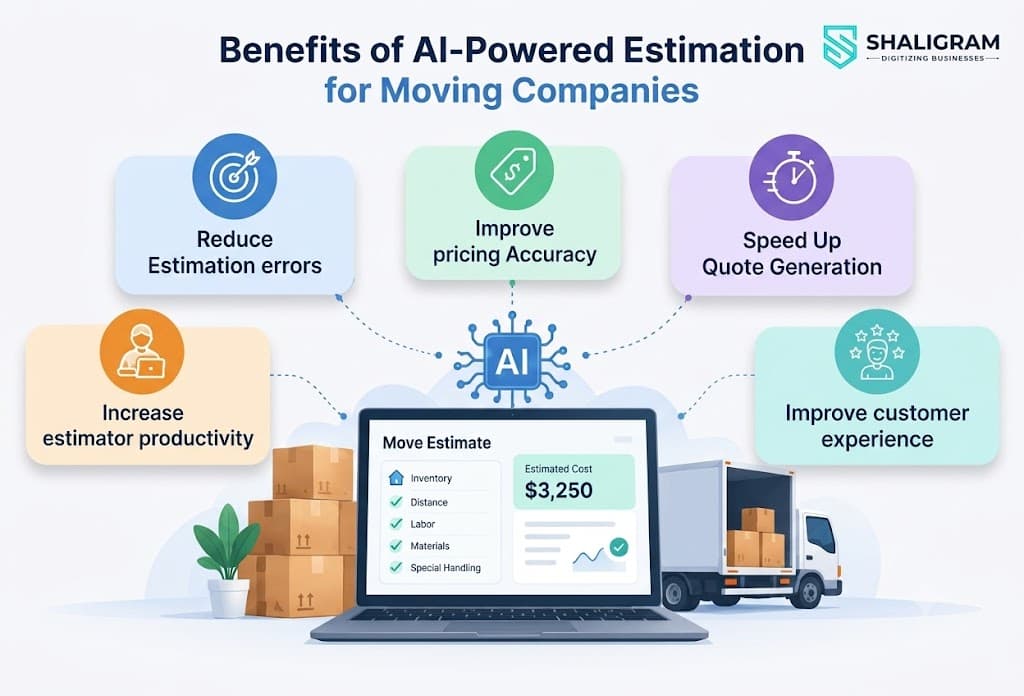
Benefits of AI-powered estimation for moving companies
What are the advantages of AI-driven moving estimates?
- Reduce estimation errors
- Improve pricing accuracy
- Speed up quote generation
- Increase estimator productivity
- Improve customer experience

Want SHALIGRAM to help your moving company automate estimation and pricing?
Our AI development team has experience building AI-powered estimation solutions, AI-integration solutions with moving platforms, and custom AI workflows for your moving operations.
The big takeaways for moving companies
Speed, precision, transparency, and technology adoption including AI is a competitive advantage for the movers and packers businesses.
What top movers do differently
Moving companies are not just chasing growth anymore.
They respond faster, monetize better, and function with data-driven insights.
The moving services companies are widely adopting digital logistics, artificial intelligence, and cloud-powered relocation tools. Modern packers and movers companies use AI-driven virtual cost estimators, AI-powered route optimization, predictive fleet maintenance, GPS-enabled tracking, defect-detection tools, and smart inventory systems to streamline operations, cut unnecessary costs, and give customers a seamless, transparent experience. From smart assistants and robotics-driven warehouses to smart packaging technologies and mobile booking apps, these innovations empower movers and packers service providers to deliver flexible, tech-forward solutions.
What it means
The future of packers and movers industry belongs to those who function smartly, intelligently leveraging AI to reduce estimation errors.
If you are operating a moving business and looking for computer vision deployment and AI integrated operations, do get in touch with SHALIGRAM.