
















How to Modernize Legacy Systems: Steps, Strategies & Best Practices
Technologies also race against time and age. Every development will have an obsolescence.
Legacy systems that fail to evolve with time are a huge burden to companies. The repercussions go unnoticed during the early stages until something drastically changes. At this juncture, fixing one thing will lead to five others. Everything after this gets harder. The deficit compounds. The cost to modernize your legacy systems grows with every year you delay the decision.
The significant problems we face cannot be solved at the same level of thinking we were at when we created them. – Albert Einstein.
Move past your legacy system crisis. Modernization will help you to scale and sustain this transformative digital landscape.
This blog outlines steps, strategies, and best practices for legacy software modernization with the right engineering processes.
What is a legacy system?
If any of your systems fail to meet your evolving business requirements even after regular updates, maintenance, and support, it may be time to classify it as a legacy system.
Sometimes, systems without the original developers also create legacy crisis as the current IT team hesitates to modify the code for fear of disrupting critical business processes.
In short, systems that are rigid, outdated, and with monolithic codebases fall under legacy systems.
What Is legacy system modernization?
Modernizing legacy systems means uplifting outdated systems. Each of these modernization approaches serves a different business purpose. To carry out what is required, understand the difference between legacy systems and legacy applications:
- A legacy system includes servers, networks, databases, services, and workflows.
- A legacy application is software with outdated frameworks or a codebase that requires modernization.
Legacy risk is a liability. That’s where legacy transformation with proper guidance is highly recommended, helping you understand what systems can be kept, what requires an upgrade, or what must be phased out.
As the best legacy system modernization services partner, SHALIGRAM, will be able to guide you to make the right choice based on your existing architecture, technical debt, budget, scalability requirements, and long-term business goals.
Why should businesses modernize legacy systems?
Legacy software modernization strengthens security against modern cyber threats, improves application performance and reliability, and reduces downtime. It lowers maintenance and infrastructure costs while making systems easier to scale, integrate with new technologies, and adapt to changing business needs. It also simplifies compliance by improving documentation, standardizing security controls, and making audits easier.
Key reasons to modernize:
- Reduce costs
- Improve security and compliance
- Adopt modern technologies like AI
- Boost scalability and agility
- Break down data silos
- Lack of talents
The point is if your business requires modern architecture that can augment your revenue, decrease operational costs, and create value, then you should go for modernizing and adapting scalable systems, provided it falls under your budget.
Legacy systems took 35% of working hours from the federal finance teams, as per a 2026 report.
The Legacy Modernization Market size is expected to grow from USD 29.39 billion in 2026 to USD 66.21 billion by 2031.
Common signs your legacy systems need modernization
- Operational warning
- Financial warning
- Security warning
These are the three common signs indicating that you need to think about legacy system transformation. Frequent downtime, inability to scale, security vulnerabilities, regulatory non-compliance, difficulty integrating and interoperating, escalating maintenance costs, shortage of talent to manage, and poor user experiences are among the most common signals prompting you to modernize your legacy systems.
As one of the best IT services companies, SHALIGRAM is well-known for its dedicated digital transformation services.
Business risks of outdated legacy applications
The risks of dealing with outdated legacy applications are high. Beyond a certain stage, the business starts shaking, operations suffer, and the impact is clear on the revenues.
To explain this with an example, we have included the latest reports from Deutsche Bank, where the company said that it was suffering from legacy systems and that, by simplifying legacy technology in its retail division, the company saw good progress.
The risk: Fragmented core banking system.
Integration and maintenance were challenging among 15 isolated systems.
Frequent disruption in customer access and service delivery.
Lack of consistency made operations difficult to manage.
Solution: Deutsche Bank implemented a new core banking platform with just two platforms. Integrations were seamless, customers were happy with zero disruption, and operations were easily manageable.
Another typical example is aging air traffic control system of U.S. Federal Aviation Administration (FAA)
The risk: 40-year-old architecture, outdated computers, aging telecommunications infrastructure, and delayed modernization.
- FAA reported aging hardware and nonfunctional components
- Disconnected systems and incompatible networks resulted in frequent operational failures
- More than 300 air traffic facilities were functioning in isolation.
- Delayed decision to modernize legacy applications caused downtime and affected the users.
- Fragile air traffic control network with analog operations.
Reuters reported that FAA will see a change in 2027 when the legacy systems are finally modernized.
What are the major consequences of delaying legacy systems modernization?
Organizations struggle when their aged systems, working models, technologies, and decisions fail to keep pace with market transformations. If a business hesitates or delays its decision to modernize its legacy systems, it will face security, operational, and financial risks. Let us explain this with two simple examples;
#1 KODAK: We all know how the famous Kodak company built its business around photographic film and traditional camera technology. The company failed to shift its film-based business to the digital photography market, simply because of the fear of innovation. The company hesitated to change. It was a rise-and-fall moment for Kodak.
#2 NOKIA: Nokia was the number one company that dominated the mobile phone market a few years ago, but lost ground when the market saw the entry of smartphones. A technology platform that once served a business became a constraint when the market shifted. Older architectures incapable of delivering new capabilities can hinder competitiveness. Here, NOKIA delayed its decision and struggled to execute a successful transition.
In both cases, we see that a delayed decision caused huge losses for the two big brands.
What we learn from this: Modernization is not easy and is an expensive process, but a delay in taking a decision to modernize your legacy systems may affect your relevance and dominance in the market.
Rising maintenance cost, security vulnerabilities, loss of expertise, sluggish time-to-market, operational downtime, loss of revenue, loss of market, and inability to scale are the major consequences of delaying legacy systems modernization.
Benefits of modernizing legacy software
While there are several viable approaches to modernizing your legacy software, it all starts with a mindset and a good partnership with a reliable service provider. The outcomes of software and service modernization are enormous, and businesses overcome the limitations that were there with outdated and non-functional systems. Organizations operate efficiently, strengthen their technology, and innovate without any disruptions with legacy application modernization.
1. New-generation architecture
Distributed modern systems and architecture ensure smooth functionality and successfully meet the demands of modern computing.
2. Security & compliance
Legacy software modernization addresses vulnerabilities with next-generation controls, resolving security and compliance gaps.
3. Reduced maintenance costs
By minimizing obsolete systems and their licenses, businesses will be able to lower maintenance costs and avoid expensive emergency fixes.
4. High scalability and flexibility
Scale simply with cloud-native architectures, microservices, and modular components.
Integration with new technologies: Integrating legacy applications with modern APIs, platforms, cloud services, AI solutions, and data analytics tools to escape data silos and to streamline workflows.
5. Improved business continuity
Reduce dependence on obsolete infrastructure, strengthen disaster recovery capabilities, and improve system resilience to minimize downtime and operational disruptions.
6. Faster innovation and time-to-market
Simplify development of workflows, automate testing and deployment, and enable teams to introduce new features faster without being constrained by outdated architecture.
7. Better decision-making
Integrated data provides real-time visibility, reliable reporting, and actionable business insights.
8. Improve productivity
Modern applications and automated workflows improves productivity.
9. Future-ready technology foundation
Integrate generative AI, machine learning, IoT, and intelligent automation to scale easily.
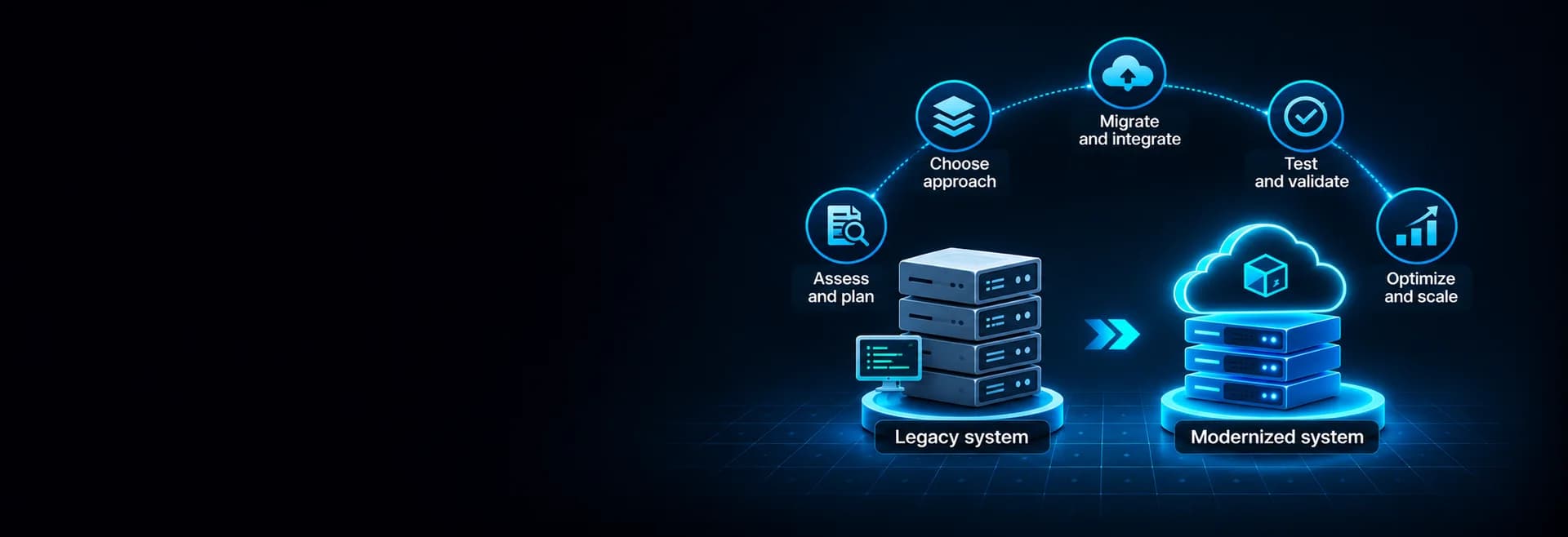
How to modernize legacy systems?
Whether you wish to modernize a few of your legacy systems or replace the entire architecture, it requires you to understand the costs, timelines, risks, integrations, and more. By weighing its long-term maintenance and the system’s ability to support your business’s future growth, you can make the right decision while working within your budget with the help of the right legacy modernization services partner.
Follow the below-mentioned legacy system modernization steps:
1. Assess Your existing legacy systems
Evaluating your existing technology stack, software architecture, technical debt, dependencies, risks, performance, and security alarms will help you have a clarity on your non-functional applications, unsupported technologies, and systems that fail to meet your current business operational requirements.
2. Align modernization goals with business values
It is important to align your legacy modernization goals with your business values. Prioritize modernizing those systems of high value, urgency, risk, and complexity, so they save costs, time, improve productivity, and support future growth.
3. Choose the right modernization approach
How you approach the system during modernization matters a lot before you decide what do you do with the legacy system. Based on the focus and the degree of transformation, there are three main categories:
i. Black-box modernization:
When the focus is on external functionality and interfaces, then modernization is categorized as a White-box approach. Rehosting and replacing are the two methods that fall under this category without modifying the internal source code.
- Migrating applications without changing their source code.
- Replacing legacy applications with modern APIs.
- Integrating legacy systems with cloud platforms.
- Replacing legacy components while preserving existing functionality.
- Testing functionality through external inputs and outputs.
ii. White-box modernization:
When the focus is on the internal code and architecture, then, the modernization is categorized as a Black-box approach. Refactoring, Rearchitecting, and Rebuilding are the methods that fall under this category where a system is replaced by altering the internal source code and modifying the components.
- Analyzing, extracting, and modifying source code.
- Modifying outdated code and business logic.
- Identifying and removing technical debt.
- Restructuring databases and application architecture.
- Modernizing APIs and internal integrations.
iii. Hybrid approach:
When the focus is to change a bit of external and internal modifications, then, the modernization falls under a hybrid approach. Replatforming falls under this category.
Comparison of Rehosting, Replatforming, Refactoring, Rearchitecting, Rebuilding, and Replacing
| Approach | Process | Outcome | Limitations | Ideal for |
| Rehosting (lift & shift migration) | Moves an application or a system from one server to another without changing the code. | Fastest migration, lower upfront cost and risk, and minimal application changes. | This is a short-term strategy. Carries forward technical debt and existing architectural limitations. | Only when applications need to move quickly. Cloud migration. |
| Replatforming | Moves applications, runtime, databases, servers, or websites from one platform to another with surface-level optimization. | Better performance, lower long-term costs, increased security, better reliability, faster deployment. | Temporary operational disruption while transitioning, technical debt, can strain resources initially. | When structural limitations affect your business growth, or when your business must operate in a different way. |
| Refactoring | Optimizing existing code without fundamentally changing the application’s architecture or intended functionality. | Reduced technical debt, easily manageable codes, simplified debugging, higher performance, and scalability. | Risks of regression and bugs, labor intensive and time consuming, over engineering, cannot fix broken architecture. | When there is a need for new features, reducing technical debt, simplifying complex functions, fix bugs quickly. |
| Rearchitecting
|
Redesigning the entire architecture with modern computing concepts without altering the core logic. | Scalable, resilient, and agile system. Cloud-native, microservices-driven environment. | Higher costs, resources drain, operational disruption, and documentation gaps. | When you face severe scalability limitations, outdated technology stacks; to unlock cloud-native capabilities. |
| Rebuilding
|
Ground-up rebuilding, designing and writing applications from scratch by completely discarding old codebase. | Modern architecture with unlimited integration and scaling potential. | Knowledge problem, continuity strain, and longer timelines. | When the old architecture stops supporting, obsolete tech stack, integrations limitations. |
| Replacing
|
Rip-and-replace, and substituting with new application, data migration, workflow rebuilding, legacy retirement. | Elimination of technical debt, totally cloud and AI compatibility, reduced workforce, minimal vendor dependency. | Loss of traditionally set business rules, high data migration complexity, downtime and disruptions. | Unsupported tech, end-of-life applications, and outgrown business models. |
4. Select the right technology stack and architecture
Selecting the right technology stack and architecture is critical during legacy IT system modernization. Go by your business requirements, scalability needs, budget, team talent, security, and compliance. Front-end, back-end, database, storage, infrastructure, and DevOps are the core components of any tech stack. To build scalable and resilient architecture, modern businesses are considering cloud, microservices, APIs, and AI integration.
Evaluate Cloud, Microservices, APIs, and AI Integration
Cloud infrastructure refers to cloud computing. Access to your business data, networks, and storage are all via the internet. Computing resources and storage systems are the core components of cloud infrastructure. Top benefits are that it offers high availability, storage, and autoscales. Cost depends on your cloud-spend and vendor-managed services.
Microservices are a technological innovation in recent days where a single application is broken down into smaller independent services that can perform a function on its own, enabling more room for future changes and scalability. It can sometime demand high operational overhead.
APIs, or application programming interfaces are the protocols that connects different software applications.
AI integration facilitates the development of intelligent applications, smart coding, and accelerates development processes.
If you are looking to implement modern, scalable, and intelligent systems, then you should think of Cloud, Microservices, APIs, and AI Integration.
5. Plan data migration and system integration
Data migration can be done in three different ways depending upon your business need and system complexity; Bing bang – where you move the entire data in one event; Phased – where you move data in portions; Parallel – where you follow live data replication method.
System integration: Either you can use middleware to translate data from legacy to modern systems; or you can follow a Dual-write or streaming approach where both the systems are synchronized. The intention is to initiate a smooth integration during the transition.
Protect Data Integrity and Maintain Interoperability
By combining strict quality controls and security protocols, combined with standardized communication, you can protect data integrity and maintain system interoperability. To carry out this, it should start from rule-based data entry, validating, auditing, and verifying data while transmission, and maintaining reliable backup and recovery methods.
6. Implement modernization in phases
Split the modernization initiative into stages instead of doing everything at once. With a clear budget, milestones, timelines, and deliverables, you can maintain business continuity throughout the transformation process.
Use Pilot Projects and Incremental Rollouts
It is always better to modernize on an incremental basis, or on a small scale before you expand it further to verify feasibility and keep focused. Incremental or phased rollouts can be either by region, department, functionality-based, workflow-based, or complexity-based.
7. Test, validate, and deploy the modernized system
Testing and validating before you deploy helps in maintaining data integrity and gather time to reconcile. It also gives room to scan vulnerabilities, which assures business continuity.
Perform Functional, Security, Performance, and Regression Testing
To ensure the best Quality Assurance (QA) strategy, it is always better to follow a strategic blend of functional and non-functional testing, which tests how the system reacts against real business requirements. Security testing ensures threat detection and elimination. Performance testing is to evaluate the speed, scalability, and stability against complex workloads. Regression testing ensures that the system functions in the new environment without any disruption.
8. Monitor performance and optimize continuously
Continuous performance monitoring and optimization is a best practice that ensures the system is running smoothly without any friction. It is an on-going simple and cost-effective method where a team of experts monitors the newly modernized infrastructure to track progress, analyze any weakness, and upgrade systems to make the project successful.
Have you lost sight of your legacy system migration?
Get back on track with SHALIGRAM.
Legacy system modernization best practices
Application modernization is more than a technical upgrade. It is a decision that a business takes to make or break its competitive edge. Today, for decision-makers, the concern around modernization is not just about the cost but about maximizing the return on that investment. Precisely, for this purpose we created application modernization best practices with suggestions on scalable custom software solutions, and cloud migration.
Prioritize high-impact applications:
Focusing on the aging systems that either bother you a lot, or cause daily pain, or affect your business growth, and increase security risks is key to successful legacy system transformation. To start with this process, you need to categorize and prioritize the legacy systems that are affecting your organization.
- Evaluate systems that block you from delivering new services or features, or those that fail to integrate with new APIs or prevent you from scaling. Prioritize these systems. Identify resources that drain.
- Applications that need to be reengineered to function as per the new requirements.
- Old and legacy systems succumb to modern vulnerabilities. Such systems need to be addressed at the earliest and integrated with modern data privacy regulations to tackle modern cyber threats.
- Applications that lack user-friendly interfaces cause poor customer experience. Such systems also need priority-based attention.
Adopt a phased modernization approach:
When a business has budget limitations, choosing whether to replace the entire existing infrastructure or update a legacy system requires analyzing and weighing the returns and value of replacement against maintenance. If your system supports your business goals, it is better to do it in phases, choose the critical ones first, and then slowly progress to other systems, rather than replacing the whole structure in one go.
Integrate security and compliance:
Legacy systems present high-level security concerns in modern threat landscapes. Modernizing legacy systems enhances security and compliance. But the process of modernization itself is prone to vulnerabilities. By following best practices and outlining strategies for mitigating risks, it is easier to have a safe, modernized system. Talk to SHALIGRAM to gain expert guidance on integrating security and compliance during legacy system modernization.
Automate testing and deployment
Implement automated testing and CI/CD pipelines to speed up releases, reduce deployment errors, and ensure consistent software quality.
Maintain data quality and integration standards
Establish data validation, cleansing, governance, and integration standards to ensure accurate, consistent, and reliable data across modernized systems.
Track ROI, performance, and business KPIs
Monitor modernization outcomes using ROI, system performance, operational efficiency, and business KPIs to measure progress and identify areas for improvement.
Prepare teams for modernized technologies
Train employees, provide technical support, and encourage change adoption to help teams confidently work with modern technologies and updated business processes.
Common legacy system modernization challenges and how to overcome them
1. High costs and budget constraints
Modernizing legacy systems will pinch your budget as it involves modernizing infrastructure, software development, data migration, testing, and employee training. For this reason, businesses should seek help from expert service providers like SHALIGRAM to assist them in identifying high-impact applications, opt for Cloud security services, and adopt an incremental modernization technique and establish a ROI-based expense plan throughout the project.
A Deloitte banking survey found that firms underestimate the true total cost of ownership of their legacy systems by 70% to 80%, with real costs landing 3.4 times above the original budget.
AI application modernization might hit your budget at the upfront, although its long-term benefits are huge and will help in eliminating unwanted costs in the long run.
2. Data migration and integration complexity
Your existing system is fragmented and outdated, with data inconsistencies. Well-planned data migration services from an experienced service provider will help ease the process of data migration and integration. Audit data, define clear migration strategies, and validate data accuracy.
3. Downtime and business continuity risks
Migration and modernization often result in business disruption during the process, which will have a high impact on customer experience and can lead to productivity losses. Reputed and experienced service providers like SHALIGRAM will help plan modernization in phases, maintain data backups, and minimize disruption.
4. Skills gaps and resistance to change
Coping with the new modernized infrastructure, applications, and workflows might be challenging for the employees, as they may lack the technical expertise to manage modern technologies. Employee training, providing hands-on knowledge guides, and establishing a structured change management process can help mitigate the skill gaps.
5. Security and vendor dependency
There are chances that you will face security vulnerabilities, compliance challenges, and dependencies during the modernization phases. Expert legacy system modernization providers like SHALIGRAM will help plan the right architecture, integrate security and compliance, and conduct regular security assessments to help you overcome these challenges.
How a structured approach reduces migration risk
Legacy system modernization is risky as it involves data threats and the chance of business disruption, which often impacts customer experiences and business growth. But, a planned approach reduces the risks. Rather than opting for a full system replacement, a phased approach lets enterprises modernize incrementally while keeping operations stable. Five practices protect organizations through the transition:
- Strategic auditing and assessment
- API-first architecture & encapsulation
- Incremental phased migration
- Data unification and clean migration
- Security-by-design and continuous monitoring
AI-powered legacy system modernization
In this context, AI is one transformative technology that every business wishes to invest in. By involving AI to strategically plan and modernize legacy systems, businesses can save time, money, and resources. 20%–50% of businesses indicated in a survey that they are already planning their infrastructure for AI adoption and integration.
Benefits of AI-powered legacy system modernization
Modernizing legacy applications involve analyzing the source code, identifying dependencies, correcting the components, and testing changes without disrupting essential operations.
- AI-driven legacy system analysis reduces risks by 30%–50%.
- AI reduces modernization timelines and deployment cycles by roughly 40% to 50%.
- Automated documentation reduces quality assurance costs by up to 40%.
- AI interprets and translates old structures into modern languages without losing the logic.
- AI-powered automated code generation follows security standards and compliance checks
- AI can automatically detect discrepancies, bugs, and rewrite code to boost application performance
- AI-based development shortens and automates development cycles, reducing manual coding to update complex software.
AI-driven development tools shorten and automate development cycles, reducing manual coding to update complex software.
Documentation of legacy applications is mostly unavailable or incomplete, and understanding the system from its source code is a huge challenge for humans. But Gen AI can interpret many obsolete coding languages, summarize low-level documentation, and identify opportunities to simplify.
The market is changing faster than ever. Technologies that seemed to be a fit in the past are falling flat today. And businesses are facing the pressure to push themselves to fit into the market and to be relevant. Those who resist innovation will lose the opportunity to stand ahead. A “wait and watch” approach will put them behind. If you are not sure where to start, pick up a reliable legacy application modernization service provider to help you change the market dynamics.
How to choose the best legacy system modernization partner?
- Assess technical expertise and industry experience
- Validate migration, integration, and security capabilities
- Look for a consulting-first modernization approach
Legacy system modernization is not an easy process, considering the complexity, software technologies and engineering processes, security, and downtime risks. For this purpose, you should partner with the best legacy system modernization services provider for comprehensive guidance. SHALIGRAM is trusted by enterprises worldwide to carry out their modernization goals successfully. By combining AI with proven architecture, we govern every phase of legacy application modernization through our digital product engineering services to make your business-critical operations scalable and continuously adaptable.
Ready to modernize your legacy systems?
Replace systems before they fail completely. Outdated systems should not stop your business from scaling and innovating. With a decade of experience and expertise in modern architecture and reengineering solutions, SHALIGRAM will be able to help you with the best legacy system modernization solution. From evaluating your existing technology and identifying modernization opportunities to building a modernization plan aligned with your business goals, the team at SHALIGRAM will handle every phase with complete accountability.

Are you looking to incrementally modernize your legacy systems?
Transform your legacy systems, modernize your architecture, and reimagine your workflows with AI under the best guidance and support from SHALIGRAM.
FAQs
Legacy system modernization takes roughly 2 weeks to 24 months depending on the approach you choose and the complexity.