

















How Much Does Legacy System Modernization Cost in 2027? A Complete Breakdown

Key takeaways
- Developers spend roughly 42% of their work week managing technical debt rather than shipping new capabilities.
- Undocumented workflows, logic, and knowledge gaps can drive up modernization costs.
- Apart from the visible costs, businesses are often shocked by hidden costs, opportunity costs, and risk costs.
- Legacy system modernization costs in 2027 will range between $25,000 and $10 million+.
- 71% of enterprise modernization projects exceeded their budget.
- AI can accelerate modernization timelines by 40 to 50%, while reducing the costs by 40%.
- Rehosting is the least costly modernization, and rebuilding is the costliest modernization approach.
- Integrations and API development drive up modernization costs.
- Phased modernization can help balance the cost.
- Selective modernization is predicted to trend in 2027.
Legacy systems are your burden. The visible costs that you see to maintain these are nowhere near the invisible long-term losses.
Businesses will be shocked to know that there are hidden costs in legacy system infrastructure costs, hosting and operations, vendor licenses and support, regulatory compliance and security, incident response and firefighting, onboarding and knowledge transfer, and technical debt.
Apart from the visible costs, businesses will also be paying opportunity costs where you may not be working at the velocity at which your competitors are working. With every missed market opportunity, the gap widens, making it harder for you to stay ahead of the competition.
Additionally, with legacy systems, your business will also have to bear risk costs where there will be operational disruption, security vulnerabilities, data loss, and more damages that are irreversible.
The question is not whether businesses should opt for legacy system modernization; the question is whether businesses can withstand the loss without opting for modernization.
As Meta CEO Mark Zuckerberg said, “The biggest risk is not taking any risk”; there is a clear indication that stagnation will sink you. You may face severe, compounding business risks.
According to SAP Community, enterprises that modernize are experiencing increased operational efficiency and market share growth. And businesses that delay modernization due to budget constraints or operational stability, are quietly disqualifying themselves from the race.
But how much does legacy system modernization cost in 2027?
Whether you are a bit selective about modernization, would like to replace every legacy application, or are just upgrading the components, there is a cost involved. Recent reports from the US Government Accountability Office (GAO) confirm that the US federal government spends over $100 billion annually on IT, with approximately 80% of the budget going toward operating and maintaining legacy systems. Moving an aging system or outdated system into a supportable architecture involves a certain budget.
This blog explores the cost of legacy system modernization, the factors influencing application migration costs, different modernization approaches, hidden expenses, and tips to maximize long-term value.
What factors influence legacy system modernization costs in 2027?
Legacy systems are tied to the most critical business functionalities like day-to-day financial transactions, inventory management, supply chain processes, and so on. However, age-old applications can make these operations increasingly disconnected, expensive, difficult to scale and align with modern applications.
Adopting cloud infrastructure, AI, automation, and data analytics demands modernizing outdated systems rather than an upgrade. There are several factors like these that impact the final cost of modernizing legacy systems. Here is the breakdown:
Age, size, and complexity of the existing system
Unsupported older systems, with massive amounts of historical data and modules with a tightly coupled architecture, can have a serious impact on the cost of modernization.
Programming languages and technology stack
Legacy application programming languages and technology stacks can increase the modernization costs by anywhere between 30% and 200%, due to a shortage of talent, dependency, and rigid monolithic architectures.
Data migration and database modernization
Unstructured and duplicated data will have to be processed through data inventory, cleaning, migration, reconciliation, and validation. These processes will definitely impact the overall cost of legacy application modernization.
Third-party integrations and API development
Legacy systems are outdated, and they function with disconnected databases. Modernizing these systems involves API development, replacing outdated connectors, and integrating applications with other enterprise applications like ERP, CRM, and other business tools. Depending upon the number of integrations, API development complexity, data structure, compatibility and testing, the modernization costs may go a bit high or low.
Cloud infrastructure and hosting costs
Transitioning legacy applications from on-premises to cloud infrastructure, be it public, private, hybrid, or multi-cloud, increases the overall legacy modernization costs.
Security, compliance, and regulatory requirements
More often, security vulnerabilities, compliance and regulatory measures involve integration of powerful access controls, two-way authentication and encryption, identity management, AI-driven security monitoring, and advanced data protection mechanisms. These requirements have a direct impact on the overall legacy modernization cost.
Developer expertise and resource availability
Experienced developers with technology expertise and specialized skills are often preferred by companies to handle modernization projects. Apart from a developer, a modernization project will also require cloud architects, data engineers, cybersecurity specialists, quality assurance engineers, and business analysts. Hiring or outsourcing these specialists will add to your modernization costs.
Testing, deployment, and maintenance
Modernization involves not just development or upgrades; it also requires deep-level validation and testing, before they are deployed. Before decommissioning the old system, there are multiple levels of bug fixes, performance optimization, and so on. All these factors have a serious impact on the overall cost of modernization.
A complete cost breakdown of legacy system modernization in 2027
Aging systems restrict agility. But the modernization processes involve not just optimizing the tools, but involve database decoupling, cloud hosting, selective migration, incremental updates, and sometimes complete rebuilding or replacement of the systems. It is critical to understand the cost breakdown. Here is a detailed explanation of the same.
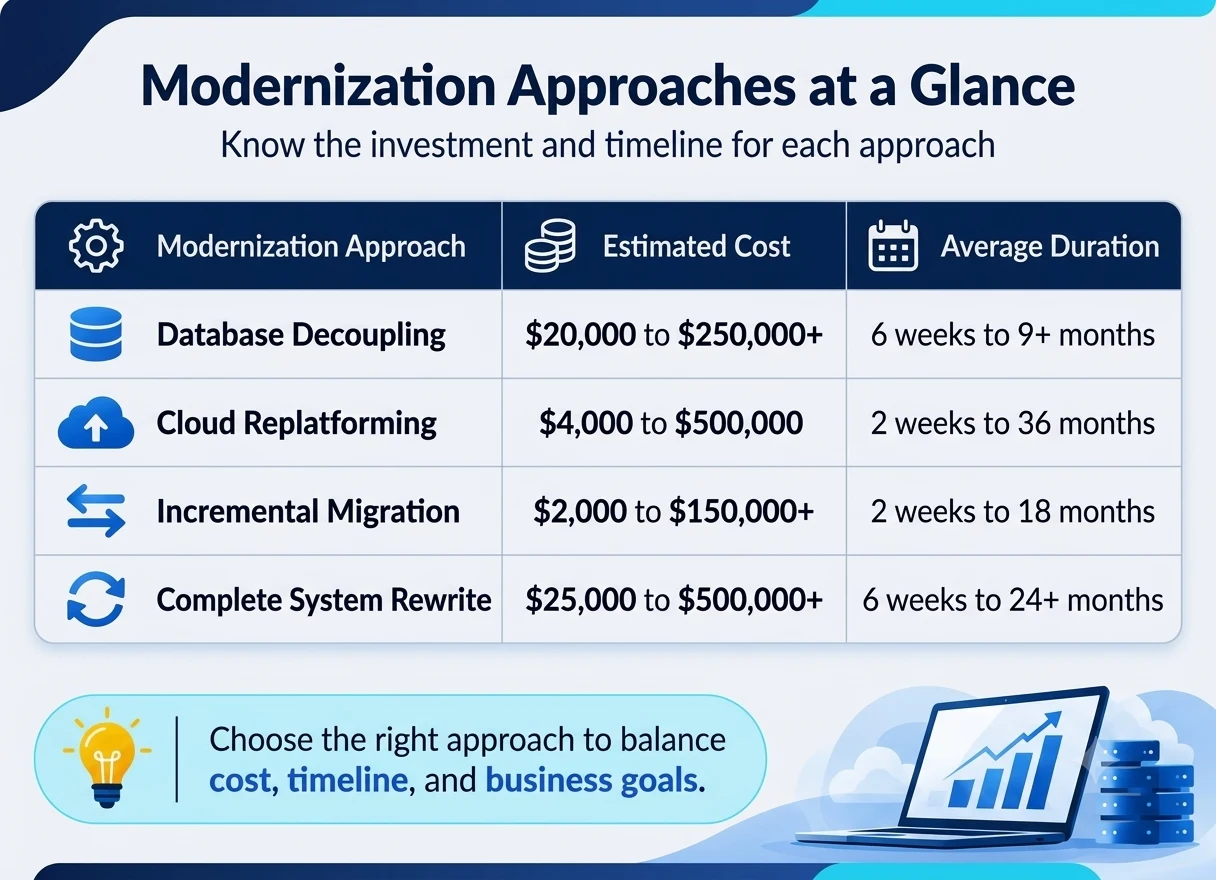
Legacy system modernization cost breakdown to watch in 2027
Here is a breakdown of the legacy system modernization cost as per each component. The cost and timeline cover every stage from initial system assessment and technical audit, application architecture and UI/UX redesign, code refactoring and application development, database migration and data validation, cloud migration and infrastructure setup, API development and system integration, quality assurance and security testing, and deployment, training, and post-migration support.
| Cost component | Approximate cost (USD) | Approximate timeline | What is covered? |
| Initial system assessment and technical audit | $5,000–$20,000 | 2–6 weeks | Codebase analysis, infrastructure assessment, dependency mapping, technical risk identification and modernization roadmap. |
| Application architecture and UI/UX redesign | $10,000–$40,000 | 3–8 weeks | Architecture planning, application structure, user interface redesign, wireframes, prototypes and user experience improvements. |
| Code refactoring and application development | $40,000–$200,000 | 2–8 months | Code restructuring, outdated framework upgrades, business logic improvements, application development and AI-assisted code conversion where appropriate. |
| Database migration and data validation | $10,000–$50,000 | 1–3 months | Data extraction, cleansing, mapping, transformation, database migration, reconciliation and data integrity checks. |
| Cloud migration and infrastructure setup | $10,000–$60,000 | 1–3 months | Cloud architecture, server configuration, environment setup, storage, networking, security controls and deployment infrastructure. |
| API development and system integration | $15,000–$80,000 | 1–4 months | API development, third-party integrations, ERP/CRM connectivity, authentication, data exchange and integration testing. |
| Quality assurance and security testing | $15,000–$60,000 | 1–3 months | Functional testing, regression testing, performance testing, vulnerability assessment, penetration testing and user acceptance testing. |
| Deployment, training and post-migration support | $10,000–$40,000 | 2–8 weeks | Production deployment, user training, documentation, monitoring, issue resolution, stabilization and post-launch support. |
How much will each legacy modernization approach cost in 2027?
Different modernization approaches have different estimates. The timeline also varies accordingly. Every geographical region can present the cost in a different way. It is better to approach the top legacy modernization service provider in the USA if you are looking for your business in the United States of America.
The planning budget for modernizing an application can range from $25,000 to several million dollars, depending on the approach, the code complexity, the data involved, the integrations, customizations, and the security and compliance requirements.
The following are the 6R approaches of legacy system modernization.
- Rehosting (Lift and Shift)
- Replatforming
- Refactoring
- Rearchitecting
- Rebuilding or Rewriting
- Replacing legacy software with a modern solution
A comparison of the cost and timeline based on the approach is as follows. These are not fixed price ranges. But can give you a rough estimate.
Legacy system modernization approach cost and timeline comparison
| Modernization approach | Approximate Cost (USD) | Approximate Timeline | What is modernized? |
| Rehosting | $25,000–$150,000 | 1–4 months | The application moved to a new infrastructure. The code is retained as such. |
| Replatforming | $80,000–$300,000 | 3–6 months | Selective changes such as upgrading .NET or containerizing. |
| Refactoring | $150,000–$600,000 | 6–12 months | The code is modified, but the functionality is retained as such. |
| Rearchitecting | $200,000–$800,000* | 9–18 months* | The architecture of the software is completely redesigned to augment scalability, flexibility, performance, and integration capabilities. |
| Rebuilding | $300,000–$1.5 million+ | 12–24 months or more | A new application is developed from scratch using modern technologies to fit the new business functionality. |
| Replacing | $300,000–$1.5 million+* | 12–24 months or more* | The current application is replaced with a new commercial or custom-built solution. Business processes and data are migrated to the new system. |
Traditional vs. AI-assisted legacy system modernization: Cost comparison to watch in 2027
Artificial intelligence and automation are strongly becoming a part of enterprise operations, empowering future-ready capabilities, enhancing agility, and unlocking new opportunities. Gone are the days when AI was merely used for content generation, search, or coding purposes. Today, AI-assisted legacy system modernization is catching up in a big way.
Here, we will help you understand the difference between traditional legacy system modernization cost and AI-assisted modernization cost.
It is a fact that AI has the potential to reduce certain project costs by accelerating code assessment, documentation, refactoring, testing, and data assessment. However, the actual cost is purely based on legacy technologies, infrastructure, complexity, data quality, integration, and more.
A recent study report from McKinsey indicates that generative AI can accelerate modernization timelines by 40 to 50%, while reducing the costs by 40%. This level of difference is purely due to automation of complex, multi-step tasks by AI, says the report.
For businesses evaluating modernization, here is a detailed comparison of the cost.
| Project size | Traditional modernization | AI-assisted modernization |
| Simple application modernization | $50K–$150K (3–6 months) |
$20K–$60K (1–2.5 months) |
| A medium-level modernization project | $180K–$270K (6–12 months) |
$72K–$108K (2.5–5 months) |
| Larger, complex, enterprise project | $500K+ (12–18 months) |
$200K+ (5–7 months) |
Traditional modernization vs. AI-assisted modernization: Key differences
Enterprises should prioritize modernization by ranking the applications by business value, technical risk, and maintenance burden. It is critical to then focus on the systems where the ROI is most evident, rather than going by the age of the system. Whether to go for traditional modernization or AI-assisted modernization is a decision that every business should evaluate. The following table is meant to give you a clean understanding of the two approaches;
| Comparison parameter | Traditional modernization | AI-assisted modernization |
| System evaluation | The code is reviewed manually. Architecture and dependencies are checked manually by developers. | Assessment of code is automated with AI tools that identify dependencies and highlight those that critically require modernization. |
| Source code review | Codes are analyzed and documented manually. | Artificial intelligence instantly identifies outdated tools, code, and potential vulnerabilities. |
| Modernization road mapping | Estimates are based on manual assessments and past project initiatives. | AI is used to assess the legacy system, and its reports help generate informed estimates. |
| Code transformation | Codes are rewritten or refactored manually by developers. | AI carries out code translation, refactoring, documentation, and new code suggestions. |
| Data transfer | Data mapping, cleansing, validation, and migration are tedious, and hands-on processes are carried out manually. | Machine learning and generative AI accelerate data migration processes. |
| Performance testing | Developers create and execute test cases manually or through conventional automation frameworks. | AI help generate test cases, identify edge cases, analyze failures, and prioritize testing activities. |
| Technical documentation | Manual documentation by the technical teams. Time-consuming, and prone to errors. | AI generates rapid, consistent, and scalable technical documentation, and workflow descriptions. |
| Delivery schedule | Time-consuming due to extensive manual analysis, development, and testing. | Rapid analysis and development. Accelerates activities by automating repetitive tasks |
| Total cost analysis | Very high costs due to developer hours, project duration, infrastructure, and testing requirements. | Reduces modernization costs by 30% to 50% and minimizes delivery timelines nearly in half. |
| Human intervention | Developers and architects handle most modernization activities. | Developers, architects, and AI tools handle the most, but collaborate with humans for key decision-making. |
How is AI transforming the legacy modernization process in 2027?
AI-driven modernization and development make the legacy modernization process more efficient in several ways. Artificial intelligence models have the capabilities to scan large codebases and identify dependencies, outdated components, and potential risks very quickly. Generative AI helps in code conversions, refactoring, and suggest improvements. AI can speed up testing and documentation. Machine learning helps in proactively identifying potential risks. Benefits include;
- Faster discovery
- Intelligent code transformation
- Optimized testing
- Better documentation
- Predictive insights
How to keep your legacy system modernization within a predictable budget?
The State of IT Modernization 2026: Enterprise Reality Report indicates that 71% of enterprise modernization projects exceeded their budget.
In fear of something going wrong, legacy system modernization projects, especially the rebuild approaches, are paused, or scaled back, or completely abandoned. However, in several other cases, businesses often feel that modernizing legacy applications consumes too much time, money, and effort and thus hesitate to imitate them. Recently, to avoid budget overruns in legacy system modernization, the trend has been to go for a phased modernization approach to have a controlled expense. The fact is that a few projects develop large budget overruns despite the cost or level of sophistication of the control approaches. Inaccurate initial estimates, uncontrolled additions or changes, unable to identify uncertainties; communication gaps can all contribute to budget overruns. It is advised not to commit to full scope before you actually understand the process. Phasing the modernization process splits the larger bet into smaller ones.
Phase 1: Assess
The first step is to understand what your current system contains, the code, programming language, integrations, data, and users. Then list the problems and risks in this current system. Learn how much your business spends to maintain this existing system annually. You will be able to start the process with a system map, cost baseline, and risk register.
Phase 2: Prioritize and choose an approach
Not every legacy application needs to follow the same modernization technique. For example,
COBOL, the common business-oriented language, is well-known as a stable, trustworthy framework for mission-critical applications. COBOL powers roughly 43% to 75% of banking systems and is reported to be handling 70% to 80% of global financial transactions. Nearly 95% of ATM cash withdrawals and swipes are supported by COBOL. But the language requires modernization because of knowledge gaps, mounting technical debt, and frictions in integrating with modern digital services. COBOL modernization includes a combination of AI-driven reverse engineering, cloud rehosting, improvement of selected interface, code refactoring, and strategic translation.
On the other hand, systems operating on premises data centers can be moved to cloud environments by rehosting and migration approaches, which is a type of modernization.
A few systems need to be deliberately retired. Microsoft Windows XP, Unix-derived server environments are a few that come under this category.
So, it is critical to score each system and application on business value, technical limitations, age, risk, and then decide on the right modernization approach. Our guide on how to modernize legacy systems covers this triage deeply.
Moreover, not every system needs immediate attention. Prioritize and make a wise decision. A reputed legacy application modernization company like SHALIGRAM will be able to guide you systematically.
Phase 3: Selective modernization
Suppose your business has an old ERP system containing these modules:
- Inventory Management
- Order Processing
- Customer Management
- Accounting and Finance
- Reporting and Analytics
Instead of modernizing all five modules together in one go, you could start with the Reporting and Analytics module, or any other low business risk module and then progress to the remaining modules one at a time. By doing so, there are several advantages. You will be able to assess how quickly each module is modernized, how much AI-driven modernization helped in automating the process, the compatibility issues, testing, and deployment effort and time taken for each, along with the cost per module. This way, you have control over the budget and timeline of your system modernization.
Phase 4: Migrate incrementally
Move the modernized modules gradually, one by one, so that business operations continue. If there are any errors, incremental migration will help in identifying, isolating, and correcting those errors. Moreover, with a controlled migration, you will be able to validate data accuracy.
Phase 5: Retire the old, and switch to the new system
Once the modernization process is over, it is time to recommission the old ones, retire them, and switch your business operations to the newly built or assembled applications. This is a very critical phase as it allows you to adjust resources, reduce unnecessary licenses, reduce operational expenses, payments, and simplify business operations.
How can SHALIGRAM help you with cost estimation and processing of your legacy modernization?
Every legacy application requires a different modernization approach. SHALIGRAM follows a consulting-first approach to understand your existing technology landscape, evaluate modernization possibilities, and identify the most practical transformation strategy. Our modernization experts assess and prepare a project-specific, and the most realistic estimate.
SHALIGRAM will help you understand the expected investment, implementation timeline, and potential long-term benefits.
Modernize with clarity. Opt for selective modernization.

Are you looking for the best legacy application modernization services company?
Look no further. SHALIGRAM is your one-stop solution for all your legacy application modernization requirements.
2027 will see selective modernization!
Legacy system modernization costs refer to replacing your outdated IT infrastructure. Most organizations fail to estimate the costs.
Most organizations are aware that their legacy systems are old. Many are even aware of the attached cost to keeping them alive. What businesses fail to recognize is the risk spread across maintenance contracts, productivity loss, security vulnerabilities, and missed market opportunities. Businesses that defer modernization will face compounding maintenance complexity.
2027 will see a shift from advice-based, or trend-based, technology adoption to selective, return-on-investment-driven modernization. Rather than going for a stifling, complete replacement, businesses will adopt selective upgrades that keep the core operations intact, eliminate technical debt, and deliver measurable financial returns.
This blog has pulled back the curtain on the hidden costs of aged IT systems, breaking down each cost and providing complete tips on legacy system modernization costs that your business can act on.
If you are looking for a cost baseline and a phased estimate for your legacy system modernization project, get in touch with SHALIGRAM.
FAQs
There is no standard one-size-fits-all costing approach for legacy system modernization. Costs vary depending on the applications’ age, complexity, integrations, security, codebase, data quality, and the type of modernization you choose. An assessment by a reputed legacy system modernization service provider like SHALIGRAM is the best way to get an estimate for your project.